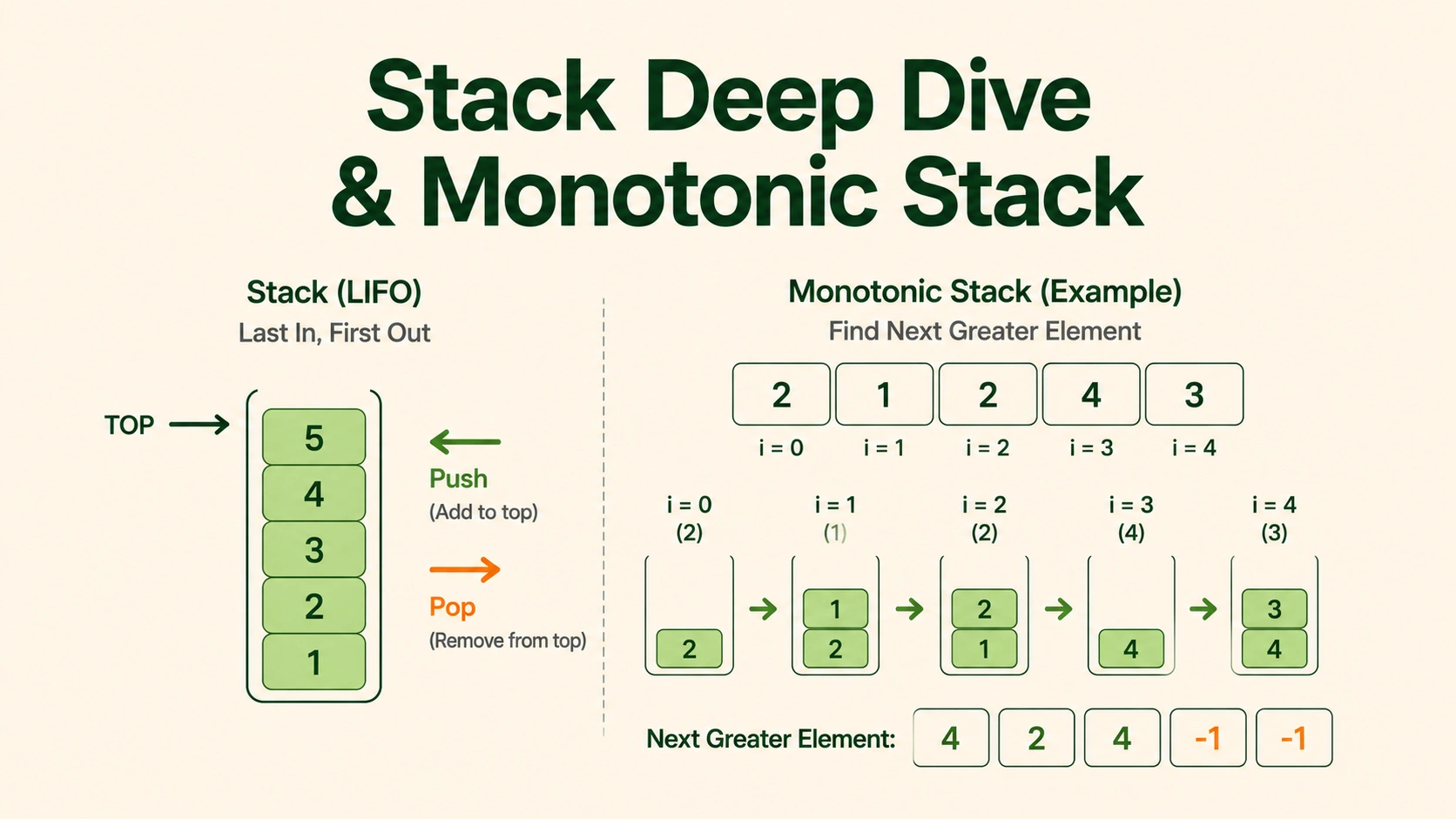
Introduction: The Super Tall Lego Block Tower
Imagine you are playing on the floor with a big box of colorful Lego blocks. You start building a single, tall tower by snapping blocks on top of each other:
- You snap a blue block on the table.
- You snap a yellow block on top of the blue block.
- You snap a red block on top of the yellow block.
This Lego tower is a perfect physical representation of a Stack in computer science!
A Stack is a linear data structure that follows the Last In, First Out (LIFO) protocol. This means the block that you put on top last (the red block) is the very first one you have to take off! If you try to pull a block out from the bottom or middle of a tall tower, the whole thing will crash down (crash-bang!) and ruin your tower. So you must only take from the top.
Let's compare this to a Queue (First In, First Out - FIFO), which is like waiting in a slide line at the playground: the kid who gets in line first goes down the slide first. In a Stack, the last kid to arrive is served first!
Core Stack Operations
A stack supports three primary operations, which are super fast and run in O(1) constant time:
- Push: Snap a new Lego block onto the top of the tower.
- Pop: Take the topmost Lego block off the tower.
- Peek / Top: Peek at the color of the topmost Lego block without removing it.
Stack vs. Queue vs. Array
Here is how Stacks stack up against other linear data structures:
| Data Structure | Access / Lookup | Search | Insertion | Deletion | Protocols / Rule |
|---|---|---|---|---|---|
| Stack | O(1) (Top block only) | O(n) | O(1) (Push) | O(1) (Pop) | LIFO (Last In First Out) |
| Queue | O(1) (Front kid only) | O(n) | O(1) (Enqueue) | O(1) (Dequeue) | FIFO (First In First Out) |
| Array | O(1) (Direct index) | O(n) | O(n) (O(1) at end) | O(n) (O(1) at end) | Random Access |
Use Cases of Stacks in Software
Stacks are hidden inside many games and programs you use every day:
- The Undo Button (Ctrl+Z): When you paint or write, every action is pushed onto an
undostack. When you hit undo, the top action is popped off and erased in reverse order! - Syntax Parsing: Checking if brackets or HTML tags are closed properly (like matching Left and Right Cozy Socks).
- The System Call Stack: When a function calls another, the computer pushes variables onto a stack. If a function calls itself too many times without stopping, the tower grows too high and collapses—this is called a Stack Overflow error!
Core Algorithmic Patterns and Templates
Let's study the three most common Stack patterns with complete code in Python, Java, C++, and TypeScript.
Pattern 1: Parentheses & Bracket Validation (The Cozy Socks Matching Game)
Imagine your mom gives you a big pile of cozy winter socks. Each sock is either a Left Cozy Sock (like (, [, {) or a Right Cozy Sock (like ), ], }).
As you look through the pile:
- Every time you see a Left sock, you throw it onto a tidy stack on your bed (Push).
- Every time you see a Right sock, you check the top sock of the stack on your bed. It must match the Right sock perfectly! (e.g. a right blue sock with a left blue sock).
- If it matches, you pack them together and remove the left sock from your bed stack (Pop).
- If it doesn't match, or if you get a right sock but the bed stack is empty, then they are not paired correctly!
- At the end, if there are still leftover socks on your bed, the socks are not paired correctly!
Complete Implementations
Given a string containing just the characters '(', ')', '{', '}', '[' and ']', determine if the input string is valid.
The Strategy
- Loop through characters of the string.
- If we see an opening bracket (
(,{,[), push it onto the stack. - If we see a closing bracket:
- If the stack is empty, there is no matching opening bracket. Return
false. - Pop the top element from the stack and verify it matches the closing bracket type. If not, return
false.
- If the stack is empty, there is no matching opening bracket. Return
- After the loop, if the stack is empty, return
true(all brackets closed). Otherwise, returnfalse(some opening brackets remained unclosed).
Watch how a stack is used to ensure opening and closing brackets match correctly in a string.Valid Parentheses
Complete Implementations
Pattern 2: Min Stack (Constant Time Min Tracking)
Design a stack that supports push, pop, top, and retrieving the minimum element in constant O(1) time.
The Strategy
To get the minimum value in O(1) time, we cannot scan the stack (which would take O(n) time). Instead, we use a secondary helper stack that keeps track of the minimum value at each stack level.
- When pushing a value
X, we push it onto the main stack. - We push
min(X, minStack.peek())onto our min-tracking stack. - When popping, we pop from both stacks.
- To retrieve the minimum, we simply return the top element of the min-tracking stack.
Complete Implementations
Pattern 3: Monotonic Stack (Next Greater Element)
A Monotonic Stack is a stack that maintains its elements in a strictly sorted order (either increasing or decreasing). It is used to solve "Next Greater Element" type queries on range values in O(n) linear time.
The Strategy
Imagine you are standing in a line of people of different heights, looking to the right. For each person, you want to know who is the first person to their right that is taller than them.
- Loop through the array from left to right.
- While the stack is not empty and the current element is greater than the element corresponding to the index at the top of the stack:
- We have found the Next Greater Element for the index at the top of the stack!
- Pop the index, write the current element as the answer for that index.
- Repeat.
- Push the current index onto the stack.
Trace Table: nums = [2, 1, 2, 4]
| Index | Value | Stack State (Indices) | Compare Value with Stack Top Value | Action | Result Array |
|---|---|---|---|---|---|
| - | - | [] | - | Initial State | [-1, -1, -1, -1] |
| 0 | 2 | [0] | Stack is empty | Push index 0 | [-1, -1, -1, -1] |
| 1 | 1 | [0, 1] | 1 > nums[0] (1 > 2) is False | Push index 1 | [-1, -1, -1, -1] |
| 2 | 2 | [0, 2] | 2 > nums[1] (2 > 1) is True | Pop index 1, result[1] = 2, Push 2 | [-1, 2, -1, -1] |
| 3 | 4 | [] | 4 > nums[2] (4 > 2) is True, 4 > nums[0] (4 > 2) is True | Pop index 2, result[2] = 4, Pop 0, result[0] = 4, Push 3 | [4, 2, 4, -1] |
Every element is pushed onto the stack exactly once and popped at most once, which guarantees O(n) time!
Complete Implementations
Pattern 4: Advanced Monotonic Stack (Largest Rectangle in Histogram)
The ultimate test of monotonic stack understanding is calculating the largest rectangular area in a histogram.
The Strategy
Imagine a skyline of buildings (the histogram). For any given building, the maximum rectangle that can be formed using its full height is bounded by the first shorter building to its left, and the first shorter building to its right.
- We maintain a stack of indices, ensuring the heights of these indices remain strictly in increasing order.
- Loop through each bar. If we encounter a bar that is shorter than the bar at the top of our stack, we know we have found the right boundary for that taller bar!
- We pop the top index. Its height is
heights[popped_index]. Its left boundary is the new top of the stack (the nearest shorter bar to the left). Its right boundary is our current indexi. - We calculate the area:
height * (right_boundary - left_boundary - 1). - We push the current index
ionto the stack and repeat. - A dummy height of
0at the end forces all remaining bars in the stack to pop and calculate their areas.
Visualize how elements are pushed and popped to maintain a strict increasing/decreasing order, solving next greater element problems in O(n).Monotonic Stack
Complete Implementations
Common Interview Pitfalls and Debugging Strategies
Stack programming is simple but has several critical runtime traps:
1. Popping from an Empty Stack (Stack Underflow)
- The Trap: Calling
pop()orpeek()on an empty stack structure, causing a crash or runtime exception. - The Fix: Always check
if (!stack.isEmpty())orif (stack.length > 0)before invoking any lookups or deletions.
2. Monotonic Stack Index vs. Value Confusions
- The Trap: Storing indices in the monotonic stack, but comparing them as values (e.g.
nums[i] > stack[-1]instead ofnums[i] > nums[stack[-1]]). - The Fix: Double-check your array lookups. If your stack stores index coordinates, you must reference the array values:
nums[stack.top()].
3. Stack Overflow in Recursion
- The Trap: Writing recursive functions that do not hit a terminating base case, running out of system stack frames.
- The Fix: Every recursion path must lead closer to a base case. If recursion depth can exceed ~10,000, rewrite the recursion as an iterative loop utilizing an explicit, heap-allocated Stack structure.
Practice Problems & Website Verifications
Deepen your stack optimization skills by practice solving these problems:
- Valid Parentheses — Standard matching brackets using LIFO push/pop.
- Min Stack — Retrieve minimum elements in constant time with dual stack configurations.
- Daily Temperatures — Apply the monotonic index distance template.
- Largest Rectangle in Histogram — Advanced monotonic stack boundary detection.
Interactive Visualizations
Engage with these concepts dynamically. Click on any card below to launch the interactive simulator and step through the algorithm execution.
Valid Parentheses
Watch how a stack is used to ensure opening and closing brackets match correctly in a string.
Monotonic Stack
Visualize how elements are pushed and popped to maintain a strict increasing/decreasing order, solving next greater element problems in O(n).