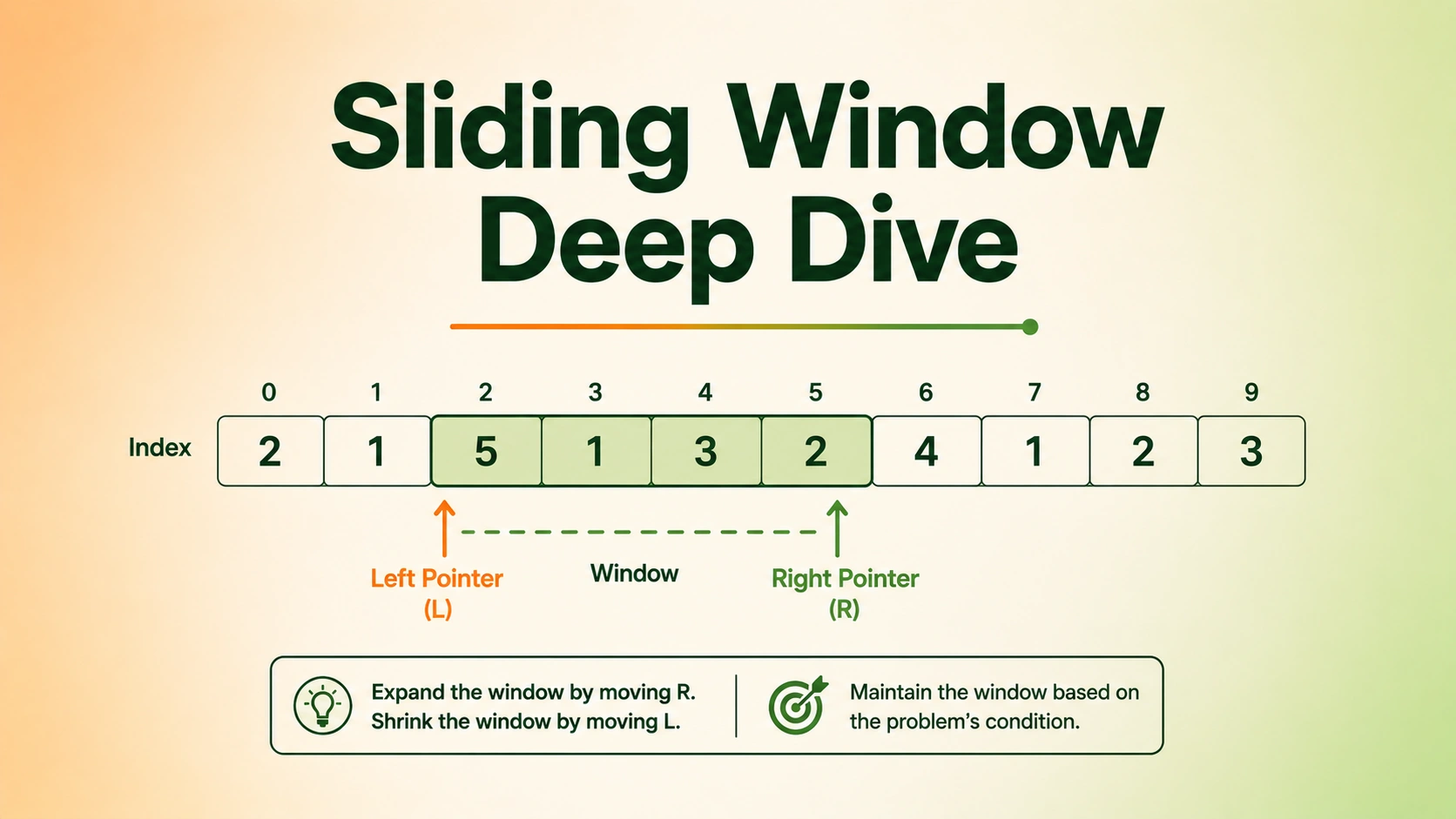
Introduction: The Magical Camera Frame
Imagine you are holding a long strip of paper containing cute little animal drawings: "Dog, Cat, Monkey, Panda, Lion, Tiger, Bear". You are holding a cardboard cutout of a camera frame that is exactly wide enough to see 3 animals at once (so it shows "Dog, Cat, Monkey").
If you want to find the features of every group of 3 adjacent animals:
- The Squeaky-Squeak Way (Brute Force): You place the frame over the first 3 animals (Dog, Cat, Monkey) and read them. Then you lift the frame, shift it one slot to the right, place it back down, and read all 3 animals all over again (Cat, Monkey, Panda). If the strip is 1,000,000 animals long and your frame is 50,000 animals wide, you will perform 50 billion checks! In computer science, this is
O(n * k)time. That is so slow, you'd fall asleep! - The Sliding Window Way (Sliding the Frame): Instead of lifting the frame, you just slide it smoothly one slot to the right! As you slide it:
- The animal on the far left exit ("Dog") slides out of the frame.
- The animal on the far right entry ("Panda") slides into the frame.
- The middle animals ("Cat" and "Monkey") stay inside, and you don't need to look at them again!
By only subtracting the one that left and adding the one that entered, you get the new answer instantly! This takes a single pass: a super fast O(n) time, regardless of how wide the frame is!
In computer science, Sliding Window is a neat optimization where we convert nested loops on arrays or strings into a single linear pass by sliding a frame represented by two pointers (left and right).
See how left and right pointers define a dynamic window that expands and contracts to find optimal subarrays or substrings.Sliding Window
Anatomy of a Sliding Window
We group sliding window problems into two fun types:
1. Fixed-Size Window (The Steady Frame)
The width of our camera frame is constant (let's call it K).
- How it works: Pointers
leftandrightstay at a fixed distance:right - left + 1 = K. - Action: As the frame slides, add
nums[right]to your bag, subtractnums[left]from your bag, and move both pointers by 1!
Initial Window (Size 3):
[ 4,   2,   1,   7,   8,   1,   2 ]
  ^         ^
left      right  (sum = 4 + 2 + 1 = 7)

Slide Window:
[ 4,   2,   1,   7,   8,   1,   2 ]
       ^         ^
     left      right  (new_sum = old_sum - 4 + 7 = 10)
2. Variable/Dynamic-Size Window (The Stretchy Window)
The width of our window grows or shrinks like a rubber band depending on the toys inside!
- How it works: Pointers start together:
left = 0,right = 0. - Stretching Right: You move
rightforward to make the window bigger, looking for more toys until you break a rule (like getting a duplicate toy). - Squeezing Left: When you break a rule, you move
leftforward to make the window smaller, until the toys inside are valid again! - Finding the Best Size: We measure the biggest or smallest size (
right - left + 1) during the valid states.
Stretching Right:
[ A,   B,   C,   A,   B ]
 ^           ^
left       right  (Bag = {A, B, C}, Perfect!)

Too Many A's! (Squeezing Left):
[ A,   B,   C,   A,   B ]
       ^         ^
     left      right  (Bag = {B, C, A}, Happy again!)
Operations & Complexity Profile
Here is how the Sliding Window speeds up contiguous scanning:
| Operation / Subarray Scenario | Brute Force Complexity | Sliding Window Complexity | Auxiliary Space (Brute Force) | Auxiliary Space (Sliding Window) |
|---|---|---|---|---|
| Max Sum Subarray of size K | O(n * k) | O(n) | O(1) | O(1) |
| Longest Substring without Duplicates | O(n^2) | O(n) | O(min(n, m)) | O(min(n, m)) (Hash Set) |
| Longest Subarray with Sum <= S | O(n^2) | O(n) | O(1) | O(1) |
| Minimum Window Substring | O(n^3) | O(n) | O(1) | O(k) (Hash Map) |
Core Algorithmic Patterns and Templates
Let's explore the three most common Sliding Window patterns with complete code in Python, Java, C++, and TypeScript.
Pattern 1: Fixed-Size Window (Maximum Sum Subarray of Size K)
Given an array of positive integers and a number K, find the maximum sum of any contiguous subarray of size K.
The Strategy
- Calculate the sum of the first
Kelements. - Initialize
max_sum = current_sum. - Slide the window from index
Kto the end of the array. At each step, add the entering element and subtract the exiting element. - Update
max_sum = max(max_sum, current_sum).
Complete Implementations
Pattern 2: Dynamic Window (Longest Substring Without Repeating Characters)
Given a string s, find the length of the longest substring without repeating characters.
The Strategy
- Initialize a Hash Set to track characters currently inside the window.
- Initialize pointers:
left = 0,max_len = 0. - Loop
rightfrom0to the end of the string. - If
s[right]is already in the set (a duplicate), shrink the window from the left by removings[left]from the set and incrementingleftuntil the duplicate character is gone. - Add
s[right]to the set. - Calculate window size:
right - left + 1and updatemax_len.
Trace Table: s = "abcabcbb"
| Right | Char | Hash Set State | Action | Left Index | Window Length (r - l + 1) | Max Length |
|---|---|---|---|---|---|---|
| 0 | 'a' | {'a'} | Add to set | 0 | 1 | 1 |
| 1 | 'b' | {'a', 'b'} | Add to set | 0 | 2 | 2 |
| 2 | 'c' | {'a', 'b', 'c'} | Add to set | 0 | 3 | 3 |
| 3 | 'a' | {'b', 'c', 'a'} | Duplicate 'a': remove s[0], l++ | 1 | 3 | 3 |
| 4 | 'b' | {'c', 'a', 'b'} | Duplicate 'b': remove s[1], l++ | 2 | 3 | 3 |
| 5 | 'c' | {'a', 'b', 'c'} | Duplicate 'c': remove s[2], l++ | 3 | 3 | 3 |
| 6 | 'b' | {'b'} | Duplicate 'b': remove s[3], s[4], l+=2 | 5 | 2 | 3 |
| 7 | 'b' | {'b'} | Duplicate 'b': remove s[5], s[6], l+=2 | 7 | 1 | 3 |
Complete Implementations
Pattern 3: Dynamic Window with Map (Minimum Window Substring)
Given two strings s and t, return the minimum window substring of s such that every character in t (including duplicates) is included in the window.
The Strategy
- Use a Hash Map
countTto record character counts for stringt. - Maintain a Hash Map
windowto record character counts of the current substring ins. - Track the number of characters that have met their target frequency:
have = 0andneed = countT.size(). - Expand the window by moving
rightforward. Ifs[right]is a target character, increment its count inwindow. If its count matchescountT, incrementhave. - While
have == need, update the minimum window answer, then shrink the window from the left by removings[left], decrementing its count inwindow, and updatinghaveif its count falls below target, then incrementingleft.
Visualize using a dynamic sliding window with hash maps to find the shortest substring containing all required characters.Minimum Window Substring
Complete Implementations
Common Interview Pitfalls and Debugging Strategies
Dynamic sliding windows are highly prone to off-by-one bugs. Watch out for these three issues:
1. Off-by-One in Window Lengths
- The Trap: Calculating window length incorrectly using
right - leftinstead ofright - left + 1. - The Fix: Because indices are 0-based, the number of elements in range
[left, right]is alwaysright - left + 1. For example, ifleft = 0andright = 2, the window has 3 elements (0, 1, 2), which matches2 - 0 + 1 = 3.
2. Map Key Deletion Failures
- The Trap: Checking map sizes (like
window.size()) but forgetting to delete keys when their counts reach 0. - The Fix: In JavaScript/TypeScript and Python, checking
if character in mapwill returntrueeven if the count is0. You must explicitly delete the key:if window[char] == 0: del window[char](Python) orif (window.get(char) === 0) window.delete(char)(TypeScript).
3. Missing Inner Loop Terminations
- The Trap: Failing to advance the
leftpointer during the shrink cycle, resulting in an infinite loop. - The Fix: Verify that the
leftpointer increments on every path inside thewhileloop that shrinks the window.
Practice Problems & Website Verifications
Verify your sliding window calculations by solving these interactive problems:
- Longest Substring Without Repeating Characters — Dynamic sliding window using character duplicates.
- Longest Repeating Character Replacement — Maximize window size using count maps.
- Minimum Window Substring — Two-map lookup with expanding and contracting bounds.
Interactive Visualizations
Engage with these concepts dynamically. Click on any card below to launch the interactive simulator and step through the algorithm execution.
Sliding Window
See how left and right pointers define a dynamic window that expands and contracts to find optimal subarrays or substrings.
Sliding Window Maximum
See how a double-ended queue (deque) maintains potential maximums to solve the sliding window max problem in O(n) time.