Introduction: The Magic Russian Nesting Dolls
Imagine you are given a giant, beautifully painted wooden doll. It's a special type of toy called a Russian Nesting Doll (or Matryoshka doll). Your friend tells you there is a shiny gold coin hidden inside the very smallest doll, and you want to find it!
How do you find the coin?
You open the big giant doll, and inside... is another doll! It looks exactly like the first one, just a little bit smaller. You open that smaller one, and inside is another doll! You keep opening dolls, one by one. Eventually, you reach the very tiniest doll. This doll doesn't open into another doll. It is the end of the line. You pop it open, and there is the gold coin!
This is exactly how Recursion works in computer programming!
Recursion is simply a function that calls itself. Instead of trying to solve a giant problem all at once, a recursive function solves a big problem by breaking it down into a slightly smaller version of the exact same problem.
What Exactly IS Recursion?
In normal programming, you might write a function called makeSandwich(). That function goes to the fridge, gets bread, and makes a sandwich.
But what if makeSandwich() opened the fridge, took out one piece of bread, and then yelled, "Hey, makeSandwich(), can you finish this?" That is Recursion! The function is handing the job to a clone of itself, but giving the clone a slightly smaller job to do.
When a computer program uses recursion, it is basically opening nesting dolls over and over until it finally finds the prize at the center.
Why Do We Need To Learn It?
You might think: "I already know how to use FOR loops and WHILE loops. Loops are easy! Why do I need to learn Recursion?"
For counting from 1 to 10, loops are better! But computers have to deal with things that are much more complicated than simple lists.
Imagine you are looking at the folders on your computer. You have a "Documents" folder. Inside that, you have 5 more folders. Inside each of those, you have 10 more folders. How do you write a program to search through every single folder for a missing picture?
If you try to write that with a loop, your brain will hurt! You would need loops inside of loops inside of loops. But with Recursion, it is as simple as saying:
"Look in this folder. If you see another folder, just cast the Recursion spell on it!"
Recursion gives you the superpower to effortlessly explore massive Trees (like a family tree) and Graphs (like a map of a city) in just 3 or 4 lines of elegant code!
The Two Golden Rules of Recursion
For the magic of recursion to work without breaking your computer, every recursive function must have two very important parts.
1. The Base Case (The Tiniest Doll)
The Base Case is the stopping point. It is the smallest, easiest version of the problem that you already know the answer to without having to do any more work. It is the tiniest wooden doll that you cannot open anymore.
If you don't have a Base Case, your function will keep calling itself forever!
2. The Recursive Case (Opening the Next Doll)
The Recursive Case is where the function actually calls itself, but it must pass a smaller version of the problem. You are taking the big doll, opening it, and handing the smaller doll to yourself to open. Every time the function calls itself, it must get closer and closer to the Base Case.
️ A Real-World Example: The Movie Theater Line
Imagine you are standing in a super long line to see a new superhero movie. You want to know what place you are in line. Are you 10th? 100th? You can't step out of line to count, because you'd lose your spot! How can you figure out your place?
- You tap the person directly in front of you on the shoulder and ask: "Excuse me, what number are you in line?" (Recursive Case)
- They don't know either! So they tap the person in front of them and ask the exact same question.
- This keeps happening. Everyone asks the person in front of them. The problem is getting smaller because we are moving closer to the front!
- Eventually, the question reaches the very first person at the front of the line. They look in front of them and see the ticket booth. No one is in front of them! They confidently say: "I am number 1!" (Base Case)
- The answer gets passed all the way back down the line. Person 1 tells Person 2, Person 2 tells Person 3... until the person in front of you turns around and says, "I am number 99!"
- You add 1 to their number and realize, "Hooray! I am number 100!"
Let's Look at Some Code! (Factorial Magic)
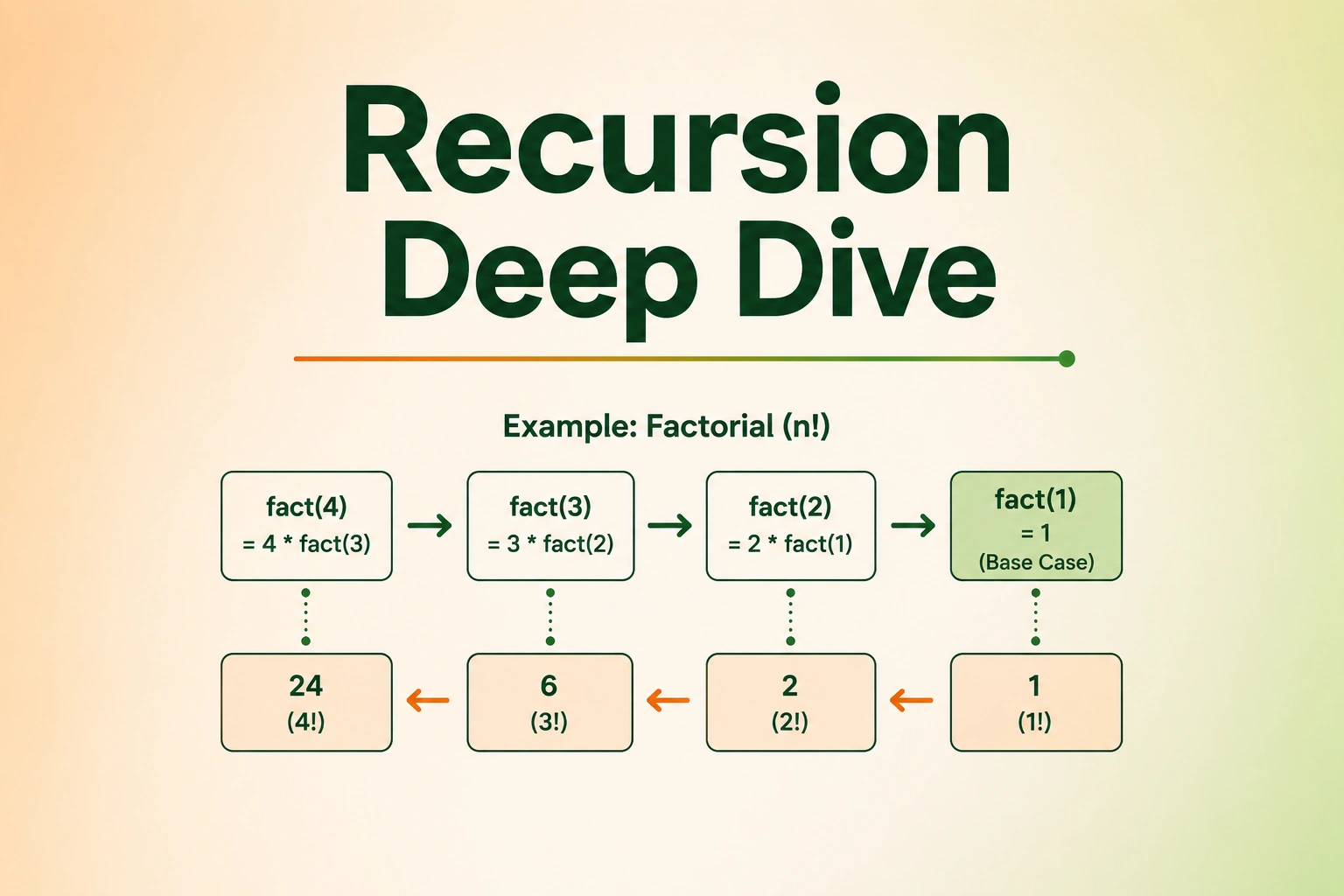
Let's write a program to calculate a "Factorial". The factorial of a number (written as 5!) means multiplying that number by every number smaller than it: 5! = 5 * 4 * 3 * 2 * 1 = 120.
Notice that 4 * 3 * 2 * 1 is the exact same thing as 4!.
That means 5! = 5 * 4!. We are breaking a big multiplication problem into a slightly smaller multiplication problem!
Complete Implementations
Problem 1: Climbing Stairs
Imagine you are climbing a staircase that has n steps. You have short legs, so you can only climb 1 step or 2 steps at a time. How many distinct ways can you climb all the way to the top?
Interactive simulator for Climbing Stairs. Step through the operations, inspect variables, and master the concepts dynamically.Climbing Stairs
The Strategy
If you want to reach step n (let's say step 10), you must have jumped there from either:
- Step 9 (by taking a 1-step jump)
- Step 8 (by taking a 2-step jump)
So, the total number of ways to reach step 10 is exactly the number of ways to reach step 9 PLUS the number of ways to reach step 8. This creates a massive branching tree of possibilities!
- Base Case: If
n = 1, there is only 1 way to climb. Ifn = 2, there are 2 ways to climb (1+1, or a big jump of 2). - Recursive Case:
climbStairs(n) = climbStairs(n - 1) + climbStairs(n - 2)
(Note: In real interviews, this pure recursive approach can get very slow for big staircases because it recalculates the same steps over and over. We usually add a memory trick called "Memoization" to speed it up!)
Complete Implementations
Problem 2: Reverse Linked List
A linked list is a chain of nodes holding hands. Node A points to Node B, which points to Node C. We want to completely reverse the direction they are pointing so C points to B, and B points to A.
Watch how pointers (prev, curr, next) are re-wired node by node to reverse a singly linked list in-place.Reverse Linked List
The Strategy
How do you reverse a chain using recursion?
- Base Case: If the list is empty or has only one node left, it is already reversed! Just return the head.
- Recursive Case: Tell your clone to magically reverse the rest of the list. Then, take the current node you are holding, and attach it to the very end of the newly reversed list.
Complete Implementations
Common Mistakes (The Infinite Loop Monster!)
When you are learning recursion, it is very easy to make mistakes. Here are the biggest traps:
- Forgetting the Base Case: If you write a recursive function and forget to tell it when to stop, your computer will just keep calling itself forever! This error is famously called a Stack Overflow.
- Not Getting Smaller: In your recursive case, you must pass a smaller version of the problem. If you call
factorial(n)insidefactorial(n), the problem never gets smaller, and you will get stuck in an infinite loop again!
Summary
- Recursion is a function that calls itself.
- Like Russian Nesting Dolls, it breaks big problems into smaller identical problems.
- It must have a Base Case (when to stop).
- It must have a Recursive Case (calling itself with a smaller problem).
- It is the absolute best way to explore branching paths, folders, and tree data structures.
Practice Problems & Website Verifications
Verify your recursion logic by solving these interactive problems on our platform:
- Climbing Stairs — Understand how Fibonacci sequences naturally map to a recursive decision tree.
- Fibonacci Number — The absolute easiest way to practice Base Cases and Recursive Cases.
- Reverse Linked List — Master how memory pointers work when the call stack unwinds.
- Merge Two Sorted Lists — Learn to build new structures recursively.
Interactive Visualizations
Engage with these concepts dynamically. Click on any card below to launch the interactive simulator and step through the algorithm execution.
Climbing Stairs
Interactive simulator for Climbing Stairs. Step through the operations, inspect variables, and master the concepts dynamically.
Reverse Linked List
Watch how pointers (prev, curr, next) are re-wired node by node to reverse a singly linked list in-place.