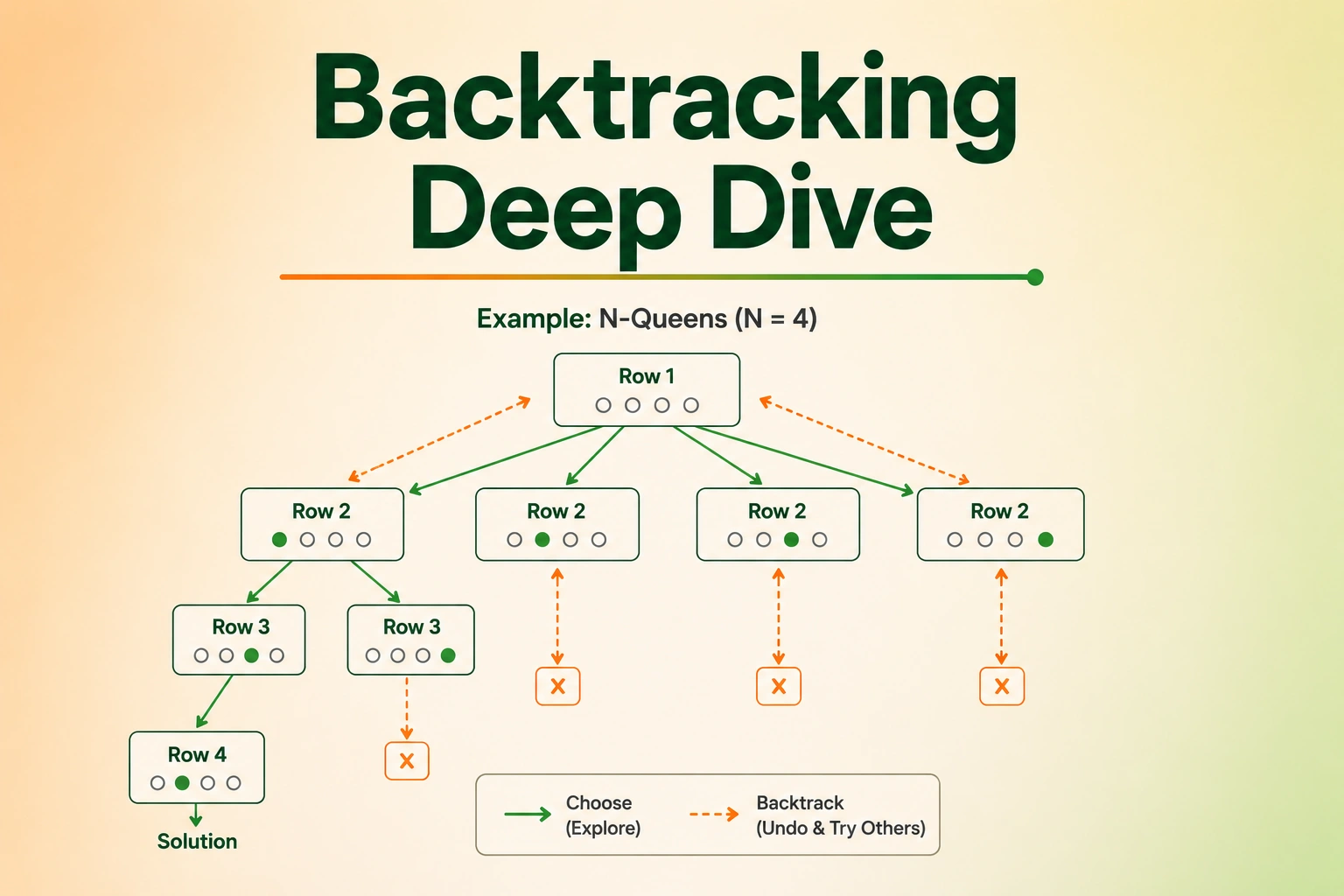
Introduction: The Great Maze Adventure
Imagine you are a brave explorer trapped inside a giant, mysterious hedge maze. Your goal is to find the hidden treasure chest right in the center. But there's a problem: you don't have a map! All you have is a pocket full of shiny breadcrumbs.
How do you find the treasure without getting lost forever?
You start walking down the first path you see. Whenever you reach a crossroad where the path splits into left, right, and straight, you just pick one—let's say the left path. As you walk, you drop breadcrumbs behind you so you know exactly where you've been.
Suddenly, oh no! A dead end! A giant wall of leaves blocks your way.
Do you sit down and cry? No! You are a smart explorer. You turn around and follow your breadcrumbs backwards until you reach the last crossroad you were at. Then, instead of going left (because you know that leads to a dead end), you try the right path!
You keep doing this: trying a path, hitting a dead end, going back a few steps, and trying a different path. Because you are checking every single path one by one, you are guaranteed to find the treasure!
In computer science, this clever strategy is called Backtracking!
What Exactly IS Backtracking?
Backtracking is a super smart way to solve puzzles by testing out possibilities one by one. It is closely related to Recursion (when a function calls itself to do a repetitive job).
Think about doing a jigsaw puzzle. You pick up a blue puzzle piece and try to fit it into the sky section. If it doesn't fit, you don't throw the whole puzzle away, right? You just take the piece out (you backtrack!), put it back on the table, and try a different blue piece.
Backtracking means making a choice, moving forward, and if you realize later that your choice was wrong (or if you just want to see all the other options), you "undo" that choice and try something else.
Why Do We Need To Learn It?
You might be thinking, "Can't I just use simple loops to solve problems?"
For simple math, yes! But what if you are trying to write a computer program that plays Chess? Or solves a Sudoku puzzle? Or finds the fastest route for a delivery truck?
Loops are terrible at making complicated choices. If a Sudoku puzzle requires guessing a number, and then guessing 50 more numbers based on that first guess, a simple loop would break.
We need Backtracking because it gives computers the superpower to explore millions of different futures! It lets the computer say: "Let's pretend I put a 5 here. What happens next? Oh, I lose the game. Let me erase the 5 and pretend I put a 6 instead."
It is the foundation of Artificial Intelligence in board games!
The Three Magic Steps of Backtracking
Every backtracking algorithm follows three magical steps. We call them: Choose, Explore, and Un-choose. Let's look at how they work using an Ice Cream Shop example.
You want to make a 2-scoop sundae. The flavors are Vanilla, Chocolate, and Strawberry. We want to find every possible combination.
1. Choose (Make a guess)
At any point, you have options. You pick the very first option available.
- Example: You put a scoop of Vanilla in your bowl.
2. Explore (Keep going!)
Now that you made a choice, you keep moving forward. You use Recursion to call your function again to pick the next scoop.
- Example: You keep the Vanilla in the bowl and ask yourself, "What should my second scoop be?" You pick Chocolate. Your sundae is [Vanilla, Chocolate]!
3. Un-choose (Undo the mistake)
If your exploration leads to a dead end, or if you already explored everything down that path, you have to clean up after yourself. You take back the choice you made in step 1.
- Example: To find the next combination, you take the Chocolate scoop OUT of the bowl. Your bowl goes back to just [Vanilla]. Now you are ready to choose Strawberry instead!
Problem 1: Picking Your Toys (Subsets)
Imagine you have a toy box with a Car, a Ball, and a Doll. You want to know every possible group of toys you can pull out to play with. You could pull out nothing, just the Car, the Car and the Doll, or all three!
Interactive simulator for Subsets. Step through the operations, inspect variables, and master the concepts dynamically.Subsets
The Strategy
At every toy, we have a simple choice:
- Include the toy in our current group.
- Skip the toy.
We use our three magic steps! We choose the toy, explore what happens next, then take the toy back out (un-choose), and explore what happens if we skip it.
Complete Implementations
Problem 2: The Magic Lineup (Permutations)
Given a list of numbers (or people), return every possible order they can stand in line! This is called a Permutation.
Interactive simulator for Permutations. Step through the operations, inspect variables, and master the concepts dynamically.Permutations
The Strategy
Instead of just "include or skip", we look at our empty spots in the line. We loop through all our people, picking an available person to stand in the current spot.
- Loop through all people.
- If the person is already standing in our line, skip them.
- Otherwise, choose them for this spot.
- Explore the rest of the line.
- Un-choose them (ask them to step out of line so someone else can have a turn at that spot).
Complete Implementations
Common Mistakes (The Forgetting Trap)
The most common mistake when writing backtracking code is forgetting to Un-choose.
If you put the Chocolate scoop in your bowl, explore what happens, and then forget to take it out... your bowl will just keep getting bigger and bigger! You will end up with a sundae that is just [Vanilla, Chocolate, Strawberry, Chocolate, Vanilla...] and your code will give you completely wrong answers.
Always remember: if you add something to an array before you explore, you MUST pop() or remove() it after the exploration is finished!
Summary
- Backtracking explores all possibilities to solve a problem by systematically testing choices.
- It's required for puzzles like Sudoku, finding all combinations, and game AI.
- The golden rule is the three steps: Choose, Explore, Un-choose.
- Always remember to clean up your choices (un-choose) so the next option has a clean slate!
Practice Problems & Website Verifications
Verify your backtracking logic by solving these interactive problems on our platform:
- Combination Sum — Learn to backtrack with an unlimited supply of elements.
- Word Search — Practice backtracking through a 2D grid of characters.
Interactive Visualizations
Engage with these concepts dynamically. Click on any card below to launch the interactive simulator and step through the algorithm execution.
Subsets
Interactive simulator for Subsets. Step through the operations, inspect variables, and master the concepts dynamically.
Permutations
Interactive simulator for Permutations. Step through the operations, inspect variables, and master the concepts dynamically.
Combination Sum
Interactive simulator for Combination Sum. Step through the operations, inspect variables, and master the concepts dynamically.