Introduction: The Giant Stack of Cards
Imagine you have a giant stack of 100 messy, completely unorganized playing cards, and your job is to sort them from smallest to largest. If you try to look at all 100 cards at once, your brain will hurt!
But what if you use a clever trick called Divide and Conquer?
Here is the trick:
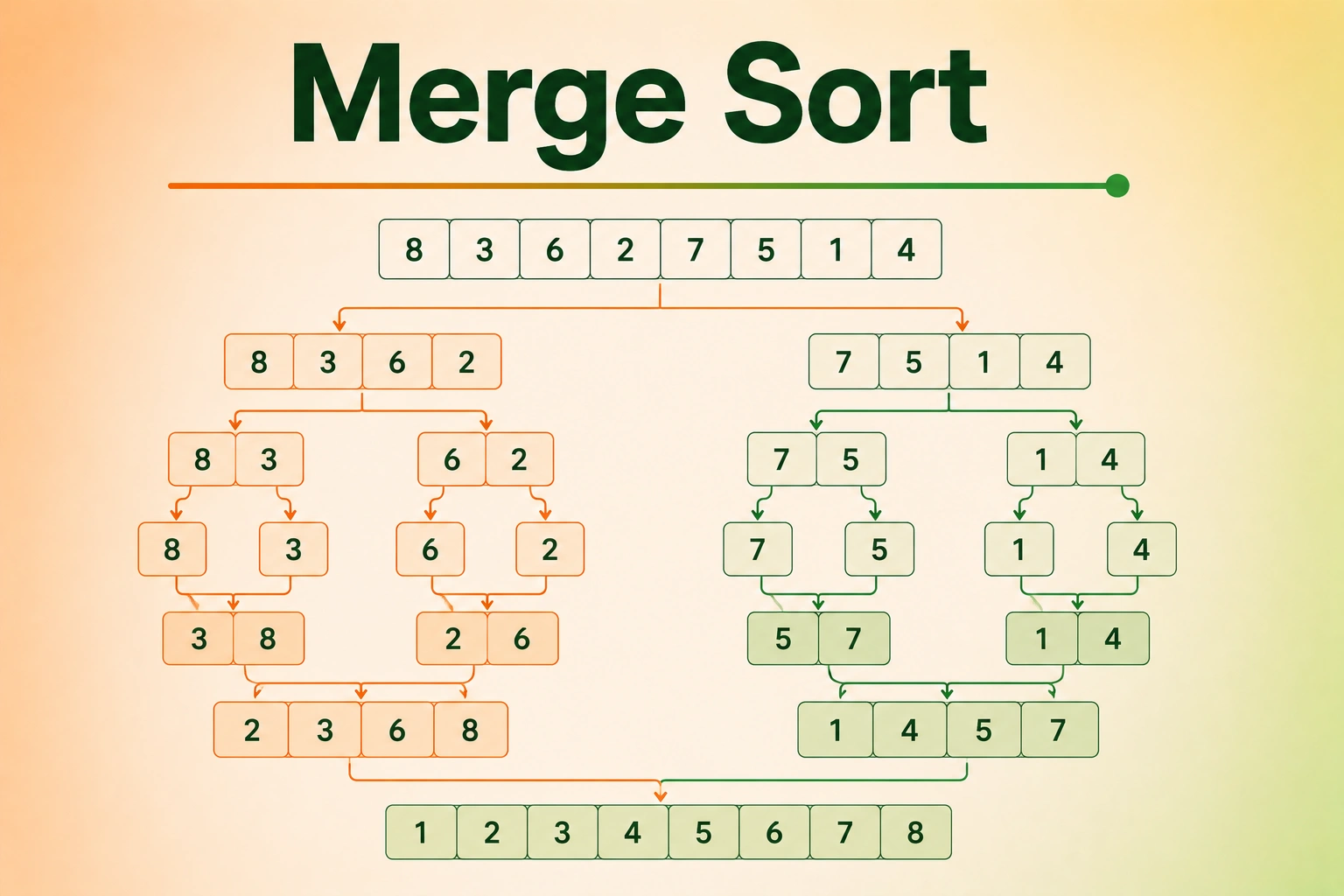
- Divide (Split): You cut the giant stack of 100 cards exactly in half. Now you have two stacks of 50. Still too big? Cut them in half again! Now you have four stacks of 25. You keep chopping the stacks in half until you have 100 tiny stacks, and each stack has exactly 1 card in it.
- Conquer (Base Case): Ask yourself: Is a stack with only 1 card sorted? YES! A single card is always perfectly sorted.
- Combine (Merge): Now, the magic happens. You take two tiny stacks (1 card each) and merge them together into a sorted stack of 2 cards. Then, you take two sorted stacks of 2 cards, and merge them into a sorted stack of 4 cards. You keep zipping these sorted stacks together until you are back to one giant, perfectly sorted stack of 100 cards!
This super-fast, incredibly reliable trick is called Merge Sort.
What Exactly IS Merge Sort?
Merge Sort is a classic sorting algorithm that uses the power of Recursion. It follows the "Divide and Conquer" strategy.
Instead of trying to sort a massive array all at once, it breaks the array down into microscopic pieces (arrays of size 1), and then builds it back up by carefully zipping (merging) the small sorted arrays together.
Why Do We Need To Learn It?
If you ever see a problem that says:
- "Sort this array in $O(n \log n)$ time"
- "Merge two sorted lists"
- "Count the number of inversions in an array"
...then Merge Sort or its helper function (the merge step) is exactly what you need!
While simple sorting loops (like Bubble Sort or Insertion Sort) get incredibly slow when you have a million items (they take $O(n^2)$ time), Merge Sort easily handles massive amounts of data because it runs in a blazing fast $O(n \log n)$ time!
The Two Magical Steps of Merge Sort
Every Merge Sort algorithm has two main parts:
1. The mergeSort Function (The Chopper)
This function is a Recursive function. Its only job is to chop the array in half, cast the mergeSort magic spell on the left half, cast it on the right half, and then hand the two sorted halves to the merge helper function.
- The Base Case: If the array has 1 or 0 elements, just return it. It is already sorted!
2. The merge Function (The Zipper)
This is the real workhorse. It takes two arrays that are already sorted and zips them together into one big sorted array. It does this by pointing a finger at the start of both arrays, comparing the two numbers, and taking the smaller one.
Let's Look at Some Code! (The Merge Sort Template)
Here is how you implement Merge Sort to sort an array of numbers. Notice how we use a helper function to do the merging!
Complete Implementations
Problem 1: Merge Two Sorted Lists
The most common real-world use of the Merge Sort concept is the merge helper function itself! Often, you will be given two separate lists that are already sorted, and asked to combine them into one.
Visualize the merge step of two sorted linked lists by comparing head elements and linking them in sorted order.Merge Two Sorted Lists
The Strategy
We don't need the "Chopper" step here because the lists are already separated and sorted. We just need the "Zipper"!
We use a "Dummy Node" to hold the start of our new merged list. Then, we look at the heads of both lists. Whoever is smaller gets attached to our merged list, and we move that list's pointer forward.
Complete Implementations
Common Mistakes (The Infinite Recursion Monster!)
Here are the biggest traps to avoid when writing Merge Sort:
- Forgetting the Base Case: Just like in our Recursion guide, if you forget
if (len <= 1) return;, your computer will try to chop arrays in half forever until it crashes with a Stack Overflow! - Missing the Leftovers: In the
mergezipper function, thewhileloop stops as soon as one of the arrays runs out of numbers. You MUST remember to write the extrawhileloops at the end to grab any leftover numbers from the other array! - Space Complexity: Merge Sort is incredibly fast ($O(n \log n)$), but because it creates new arrays during the "Zipper" phase, it requires $O(n)$ extra memory (Space Complexity).
Summary
- Merge Sort uses "Divide and Conquer" to chop a huge problem into tiny, easy pieces.
- It uses a Recursive Chopper to split the array down to single elements.
- It uses a Zipper helper function to merge sorted halves back together.
- It runs in blazing fast $O(n \log n)$ time.
Practice Problems & Website Verifications
Verify your Merge Sort logic by solving these problems on our platform:
- Sort an Array — Practice the full Merge Sort template from scratch.
- Merge Two Sorted Lists — Master the "Zipper" step using Linked Lists!
Interactive Visualizations
Engage with these concepts dynamically. Click on any card below to launch the interactive simulator and step through the algorithm execution.
Merge Two Sorted Lists
Visualize the merge step of two sorted linked lists by comparing head elements and linking them in sorted order.