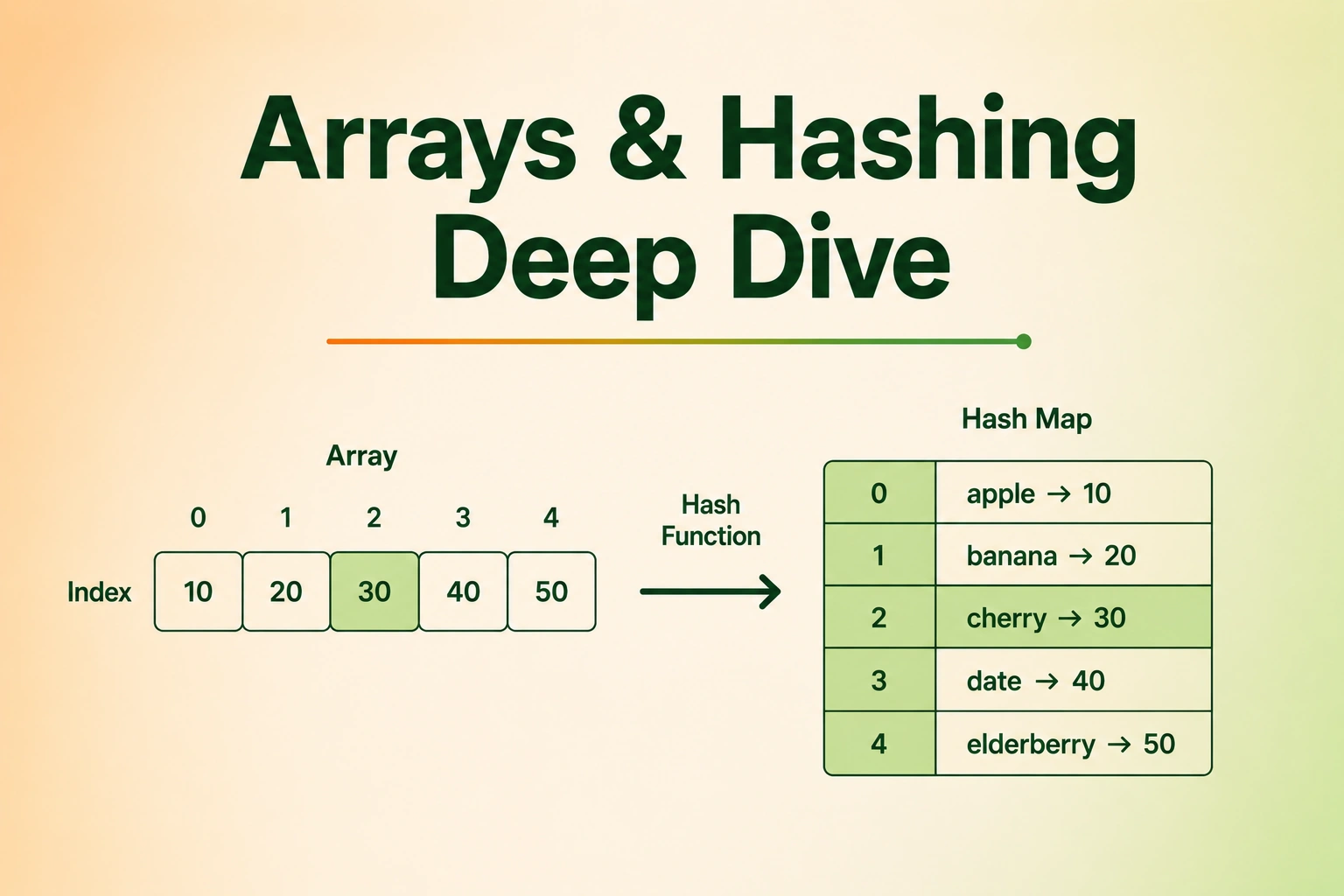
Introduction: The Magic Toybox and the Label Maker
Imagine you have a giant toy playroom with 10,000 secret colorful cubbies. You have thousands of toys: action figures, teddy bears, puzzle pieces, and crayons. One sunny afternoon, you want to find your favorite "Shiny Red Toy Robot".
How would you find it? You have two choices:
- The Long Slow Walk (Linear Search): You walk down the room, opening cubby #1, then cubby #2, then cubby #3, checking every single box. If your robot is in the very last cubby (cubby #10,000), you will have taken 10,000 steps! In computer science, this is called an
O(n)search. It works, but it's super slow and makes your feet tired! - The Magic Label Maker (Hash Map): You walk up to a friendly magical robot sitting at a desk. You type the word "Shiny Red Toy Robot" into its magic label maker keyboard. The machine does a silly sound (beep-boop-bop!) and prints: "Go to Cubby #42!". You walk straight to Cubby #42, open it, and pull out your robot! You found it in just one step! This is a Hash Table (or Hash Map) approach, achieving
O(1)constant lookup time.
The magical keyboard uses a secret mathematical recipe called a Hash Function. It takes any word (like "Shiny Red Toy Robot") and turns it into a secret cubby number (like 42) so you can store and retrieve your toys instantly!
In this guide, we will explore how these toy cubbies work, how they solve tricky problems, and how they help us build super fast programs.
Anatomy of Arrays
Before we look at the magic keyboard, we must understand the fundamental data structure that lies underneath it: the Array.
An array is a row of toy cubbies glued together in a single straight line.
Memory Address:  [ 1000 ]   [ 1004 ]   [ 1008 ]   [ 1012 ]   [ 1016 ]
Array Index:         0          1          2          3          4
Toy Value:         [  ]     [  ]     [  ]     [  ]     [   ]
1. Static Arrays (The Glued Wood Cubbies)
A Static Array is like a row of toy cubbies made of solid wood that can never change its size.
- Random Access: Because the cubbies are glued side-by-side, the computer can instantly jump to any cubby index. If each cubby is 4 inches wide, to look at cubby #3, the computer does a quick math:
Start Address + (Index * Width). For index 3:1000 + (3 * 4) = 1012. This calculation takes a tiny fraction of a second:O(1)time! - Insertion and Deletion: Adding or removing toys in the middle is slow. If you want to squeeze a new toy into Cubby #1, you must first move the toy in Cubby #1 to Cubby #2, the toy in Cubby #2 to Cubby #3, and so on, to make room! Shifting all those toys takes linear time:
O(n).
2. Dynamic Arrays (The Stretchy Cubbies)
Since solid wood cubbies cannot grow, modern programming languages give us Dynamic Arrays (like Python lists or JavaScript arrays).
- Under the Hood: A dynamic array starts as a small static array. When you add too many toys and run out of space, the computer magically creates a brand new set of cubbies that is twice as large, copies all your old toys into the new cubbies, and throws the old set away!
- Amortized Complexity: Even though copying
Ntoys takesO(n)time, this resizing double-growth doesn't happen very often. On average, adding a new toy to the end of the dynamic array still takes constant time:O(1). We call this Amortized Constant Time.
Anatomy of Hash Maps and Hash Sets
A Hash Map is a magical chest of drawers that stores {Key: Value} pairs (like {"Shiny Red Toy Robot": "Cubby #42"}). Under the hood, a Hash Map is simply a large array of drawers. To find out which drawer a key belongs to, we use our magic keyboard (the Hash Function).
Toy Name ("apple") ---> [ Magic Label Maker ] ---> Secret Code (98234) ---> [ Modulo Table Size (10) ] ---> Drawer #4
1. Hash Functions
Our magic label maker has to follow three golden rules:
- Deterministic: If you type "apple" today, tomorrow, or next year, it must always give you the exact same drawer number.
- Fast: It shouldn't take hours to compute the number. It must run instantly:
O(1)time. - Uniform Distribution: It should spread toys evenly across all drawers so drawers don't get messy and overcrowded.
2. Collision Resolution (Drawer Traffic Jams!)
Sometimes, two different toys (like "apple" and "orange") are typed into the machine, and the mathematical formula gives them the exact same drawer number (e.g. Drawer #4). This is called a Collision!
We have two clever ways to solve collisions:
- Separate Chaining (Open Hashing): Each drawer has a hanging chain of little plastic baggies. If "apple" and "orange" both land in Drawer #4, we put them both in baggies and chain them together inside Drawer #4:
Drawer 0: empty Drawer 1: [ "apple": ] -> [ "orange": ] -> empty Drawer 2: empty - Open Addressing (Closed Hashing): All elements must go directly into their own drawer. If Drawer #4 is already taken by the "apple", the "orange" goes looking for another empty drawer using a specific path:
- Linear Probing: Look at Drawer #5, then Drawer #6, then Drawer #7, until an empty drawer is found.
- Quadratic Probing: Look at Drawer #5 (1 step away), then Drawer #8 (4 steps away), then Drawer #13 (9 steps away).
- Double Hashing: Type the toy's name into a second magic keyboard to find a custom step size!
3. Load Factor and Re-hashing (Time to Get a Bigger Chest of Drawers)
If you stuff too many toys into your chest of drawers, it gets crowded, collisions happen constantly, and searching for a toy becomes slow (O(n)). We measure how full the chest is using the Load Factor:
Load Factor (λ) = (Number of toys stored) / (Total number of drawers)
When the chest is more than 75% full (λ > 0.75), the chest magically doubles its number of drawers! The magic machine then re-calculates new drawer numbers for all your toys and moves them to their new homes. This is called Re-hashing.
4. Hash Set vs. Hash Map
- A Hash Map stores pairs of
{Key: Value}. You use this when you want to retrieve a secret package (Value) using a label (Key). - A Hash Set stores only
Keyswith no values at all. You use this to quickly check: "Have I seen this toy before?" inO(1)time!
--
Detailed Operations & Time Complexities
Here is the comparison of time complexities across different array and hash configurations:
| Operation | Array (Unsorted) | Array (Sorted) | Hash Map (Average Case) | Hash Map (Worst Case - Collisions) |
|---|---|---|---|---|
| Access by Index | O(1) | O(1) | N/A | N/A |
| Search by Key/Value | O(n) | O(log n) (Binary Search) | O(1) | O(n) |
| Insert at End | O(1) (Amortized) | O(n) | O(1) (Amortized) | O(n) |
| Insert in Middle | O(n) | O(n) | O(1) | O(n) |
| Delete | O(n) | O(n) | O(1) | O(n) |
Core Algorithmic Patterns and Templates
Mastering arrays and hashing relies on three patterns:
Pattern 1: Frequency Counters
When you need to compare two groups of items, count occurrences, or find duplicates, do not use nested loops. Instead, iterate through the collection once and store the counts of each item in a Hash Map. This reduces the complexity from O(n^2) to O(n) time.
Valid Anagram
Given two strings S and T, return true if T is an anagram of S, and false otherwise.
Visualize checking if two strings are anagrams by comparing their character frequencies using Hash Maps.Valid Anagram
Trace Table of Character Counts for s = "rat", t = "car"
Length check passes (both are length 3).
| Step | Index | s[i] | t[i] | count_s state | count_t state |
|---|---|---|---|---|---|
| 0 | - | - | - | {} | {} |
| 1 | 0 | 'r' | 'c' | {'r': 1} | {'c': 1} |
| 2 | 1 | 'a' | 'a' | {'r': 1, 'a': 1} | {'c': 1, 'a': 1} |
| 3 | 2 | 't' | 'r' | {'r': 1, 'a': 1, 't': 1} | {'c': 1, 'a': 1, 'r': 1} |
After loop, count_s == count_t comparison is executed. Since count_s has key 't' (which count_t lacks) and count_t has key 'c', the comparison returns False.
Pattern 2: The Complement Lookup (Two-Sum)
When searching for a pair of numbers that satisfy an equation (like A + B = Target), you can rewrite the equation as B = Target - A.
As you iterate through the array, treat the current element as A. Calculate the complement B and check if you have already stored B in your Hash Map. If yes, you have found the pair. If no, add A to the Hash Map.
Visualize using a hash map to find two numbers that add up to a target value in O(n) time.Two Sum
Two Sum
Find the indexes of the two numbers that add up to target.
Trace Table for nums = [3, 2, 4], target = 6
| Step | Index | Num | Complement Calculation | Complement in Map? | Action | Map State (Val -> Index) |
|---|---|---|---|---|---|---|
| 0 | - | - | - | - | Initial Setup | {} |
| 1 | 0 | 3 | 6 - 3 = 3 | No | Add 3 to Map | {3: 0} |
| 2 | 1 | 2 | 6 - 2 = 4 | No | Add 2 to Map | {3: 0, 2: 1} |
| 3 | 2 | 4 | 6 - 4 = 2 | Yes! Index is 1 | Return [1, 2] | {3: 0, 2: 1} |
Pattern 3: Prefix Sum and Map Coordination
This pattern tracks a running sum (cumulative sum) as we traverse an array. By combining this running sum with a Hash Map that stores {Prefix Sum: Index}, we can find subarrays that sum to a specific value K in O(n) time.
The logic is: if the difference between our current prefix sum and a past prefix sum is equal to K, then the subarray between those two points must sum to K.
Current Sum - Past Sum = K ==> Past Sum = Current Sum - K
Subarray Sum Equals K
Visualize how cumulative sums are precomputed to allow any subarray range sum query in constant O(1) time.Prefix Sum Array
Complete Implementations: Valid Anagram
Here is the code to check if two strings are anagrams of each other:
Complete Implementations: Two Sum
Here is the code to solve the Two Sum problem using a Hash Map:
Common Interview Pitfalls and Debugging Strategies
Avoid these typical mistakes during interviews:
1. Modifying a Key While It Is in a Hash Map
- The Problem: You cannot locate an object in the Hash Map even though it was just added.
- Why it happens: If you use a mutable object (like a list or custom class) as a key, and change its internal value, its hash code changes. The Hash Map will now look for it in a different bucket, making it unretrievable.
- The Fix: Only use immutable data types (strings, numbers, tuples) as keys.
2. Using JavaScript Objects as Maps
- The Problem: Unexpected key properties or keys casting to string representations.
- Why it happens: Plain JS objects (
{}) automatically cast all keys to strings (e.g. a key of number5becomes string"5", and a key of an object becomes"[object Object]"). Additionally, plain objects inherit properties from the prototype chain. - The Fix: Always use the native
MaporSetconstructors in JS/TS for key-value logic, as they support any data type as keys and have no default prototype collisions.
Practice Problems & Website Verifications
Verify your arrays and hashing knowledge with these interactive problems:
- Two Sum — Match values in a single pass using a target check.
- Valid Anagram — Compare frequency structures of two text strings.
- Group Anagrams — Hash sorted words to group anagram buckets.
- Longest Consecutive Sequence — Use a Hash Set for instant lookup intervals.
Interactive Visualizations
Engage with these concepts dynamically. Click on any card below to launch the interactive simulator and step through the algorithm execution.
Prefix Sum Array
Visualize how cumulative sums are precomputed to allow any subarray range sum query in constant O(1) time.
Top K Frequent Elements
Track how a frequency map and a min-heap extract the K most common elements in O(n log k) time.
Rotate Array
Interactive simulator for Rotate Array. Step through the operations, inspect variables, and master the concepts dynamically.
Maximum Subarray
Interactive simulator for Maximum Subarray. Step through the operations, inspect variables, and master the concepts dynamically.