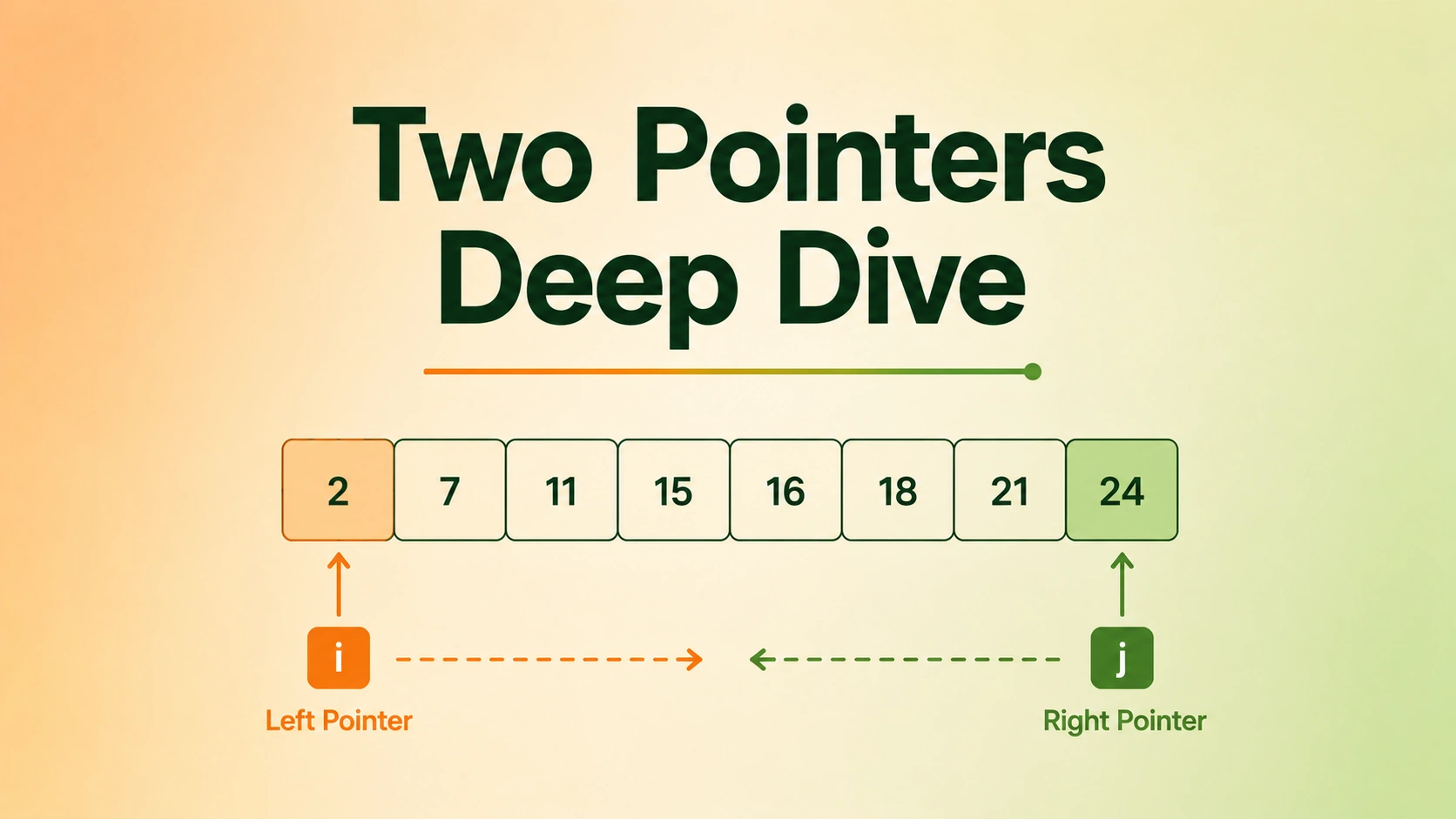
Introduction: The Crayon Friends Game
Imagine you have a long row of heavy boxes sorted by weight, from the lightest feathery toy on the left to a giant heavy boulder on the right. Your teacher asks you to find two boxes that together weigh exactly 100 pounds.
How would you do it?
You could pick up Box #1, walk down the entire line of boxes, testing it with each one. If they don't match, you walk all the way back, pick up Box #2, and walk the line again. That's a lot of walking! If there are N boxes, you might have to walk the row N * N times. In computer science, this is called the brute force approach, or O(n^2) time complexity. If there are 10,000 boxes, you'd have to make 100,000,000 checks!
Instead, let's play a game using the Two Pointers strategy with two friends, Lefty and Righty:
- Lefty starts on the far left next to the lightest box.
- Righty starts on the far right next to the heaviest box.
They look at their boxes and add their weights together:
- If the sum is exactly 100 pounds, they shout: "Hooray, we found it!" and stop!
- If the sum is too heavy (like 120 pounds), Righty takes one step to the left towards lighter boxes. Why? Because Lefty is already holding the lightest box. Since their sum is too heavy, pairing Righty's current box with any other box would be even heavier! Righty's current box can't be part of the solution.
- If the sum is too light (like 80 pounds), Lefty takes one step to the right towards heavier boxes. Why? Because Righty is holding the heaviest box. Squeezing Lefty's current box with any other box would be even lighter! Lefty's current box can't be part of the solution.
Lefty and Righty walk toward each other. In just a single pass, they find the target! They checked at most N boxes, reducing our runtime to a simple linear scan: O(n)! And because we didn't buy any new boxes, we used no extra space: O(1)!
In computer science, Two Pointers means having two index variables (like left and right) pointing to elements in an array, string, or linked list, and moving them together based on simple rules.
Anatomy and Mechanics of Pointers
To write perfect pointer code, we must understand how pointers behave. Pointers are not actual memory addresses here; they are just simple index variables representing spots in an array.
1. Opposing Pointers (Moving Inwards)
Pointers start at opposite ends of the array and walk towards each other until they meet.
- Start Line:
left = 0,right = n - 1 - Keep Going Until:
while left < right - Walking:
left++(moves right) and/orright--(moves left) - Awesome Use Cases: Reversing an array, checking if a word is a palindrome, and searching pairs in sorted arrays.
Index:    0    1    2    3    4    5    6
Array:  [ 2,   5,   8,  11,  14,  17,  20 ]
          ^                               ^
        Lefty                           Righty
        (moves ->)                 (<- moves)
2. Forward Pointers (The Tortoise and the Hare)
Both pointers move in the same direction, but one is faster than the other!
- Start Line:
slow = 0,fast = 0 - Walking: The Tortoise (slow) takes 1 step at a time, while the Hare (fast) takes 2 steps at a time!
- Awesome Use Cases: Finding the middle of a linked list or checking if a list has a cycle (loop).
Imagine running on a circular running track. If it's a normal straight track, the fast Hare will reach the end first. But if the track is a loop (cycle), the Hare will eventually run in circles and catch up to the slow Tortoise from behind, tapping them on the shoulder (slow == fast)!
Step 1:
[ Node A ] -> [ Node B ] -> [ Node C ] -> [ Node D ] -> [ Node E ] -> null
    ^
 slow, fast

Step 2:
[ Node A ] -> [ Node B ] -> [ Node C ] -> [ Node D ] -> [ Node E ] -> null
                  ^             ^
                slow          fast
Operations & Complexity Profile
Here is how Two Pointers makes operations super-fast and memory-friendly:
| Operation / Scenario | Brute Force Complexity | Two Pointers Complexity | Auxiliary Space (Brute Force) | Auxiliary Space (Two Pointers) |
|---|---|---|---|---|
| Two Sum II (Sorted Array) | O(n^2) | O(n) | O(1) | O(1) |
| Valid Palindrome | O(n) (creating reversed copy) | O(n) | O(n) (for reversed string) | O(1) |
| Reversing an Array | O(n) (with temp array) | O(n) | O(n) | O(1) (in-place swaps) |
| Cycle Detection (Linked List) | O(n) (with Hash Set) | O(n) | O(n) (storing nodes) | O(1) |
| Container With Most Water | O(n^2) | O(n) | O(1) | O(1) |
Why Pointers Save Space
Many array operations can be done by creating a brand new array, copying items over in a new order, and returning it. This takes up a lot of extra memory: O(n). Two Pointers allows you to perform operations in-place (directly inside the original array) by swapping elements using your index pointers. This guarantees a super-tiny memory footprint: O(1)!
Core Algorithmic Patterns and Templates
Let's study the four most common Two Pointer patterns with detailed explanations and implementations in Python, Java, C++, and TypeScript.
Pattern 1: Opposing Pointers (Valid Palindrome)
A palindrome is a string that reads the same backward as forward, ignoring case and non-alphanumeric characters. For example, "A man, a plan, a canal: Panama" is a palindrome.
The Strategy
- Place a pointer at the beginning (
left = 0) and one at the end (right = length - 1). - Move pointers inward, skipping any non-alphanumeric characters.
- Compare characters at
leftandright(case-insensitively). If they don't match, returnfalse. - Stop when pointers meet or cross (
left >= right).
Complete Implementations
Pattern 2: Two Sum II (Sorted Input Array)
Given a 1-indexed array of integers numbers that is already sorted in non-decreasing order, find two numbers such that they add up to a specific target number.
The Strategy
- If
numbers[left] + numbers[right] < target, we need a larger sum. We incrementleftto slide to a larger element. - If
numbers[left] + numbers[right] > target, we need a smaller sum. We decrementrightto slide to a smaller element.
Trace Table: numbers = [2, 7, 11, 15], target = 9
| Step | Left Index | Right Index | numbers[Left] | numbers[Right] | Current Sum | Comparison | Action |
|---|---|---|---|---|---|---|---|
| 1 | 0 | 3 | 2 | 15 | 17 | 17 > 9 (Too Large) | decrement right |
| 2 | 0 | 2 | 2 | 11 | 13 | 13 > 9 (Too Large) | decrement right |
| 3 | 0 | 1 | 2 | 7 | 9 | 9 == 9 (Match!) | Return indices [1, 2] (1-indexed) |
Visualize how two pointers starting at opposite ends of a sorted array converge inward to find a pair that meets a target condition in O(n) time.Two Pointers Technique
Complete Implementations
Pattern 3: Fast & Slow Pointers (Linked List Cycle)
Given the head of a linked list, determine if the linked list has a cycle in it (a loop where a node points back to a previous node in the list).
The Strategy (Floyd's Cycle-Finding Algorithm)
- Initialize two pointers at the head:
slow = headandfast = head. - Move
slowby 1 node at a time:slow = slow.next. - Move
fastby 2 nodes at a time:fast = fast.next.next. - If there is a cycle, the fast pointer will eventually wrap around and "lap" the slow pointer, meaning they will meet (
slow == fast). - If there is no cycle, the fast pointer will hit the end of the list (
null).
Visualize Floyd's Cycle-Finding Algorithm (Tortoise & Hare) where a fast pointer eventually laps a slow pointer inside a loop.Linked List Cycle Detection
Complete Implementations
Pattern 4: Container With Most Water
Given N non-negative integers heights, where each element represents a vertical line height, find two lines that together with the x-axis forms a container that holds the most water.
The Strategy
The amount of water contained is limited by the shorter line: Area = min(height[left], height[right]) * (right - left).
- Place pointers at the boundaries:
left = 0,right = n - 1. - Compute the area, updating
max_area. - To maximize the area, we want to find taller lines. Since the area is bounded by the shorter line, moving the pointer at the taller line will only decrease the width without any chance of increasing the height boundary. Thus, we should always move the pointer pointing to the shorter height inwards.
Visualize two pointers moving inward, greedily replacing the shorter boundary to find the maximum possible containment area.Container With Most Water
Complete Implementations
Common Interview Pitfalls and Debugging Strategies
Pointer code is prone to runtime errors, infinite loops, and logical bugs. Watch out for these three major traps:
1. Pointer Out-of-Bounds & Null Pointer Exceptions
- The Trap: Accessing indices beyond the array bounds (e.g.,
arr[left]whenlefthas incremented pastarr.length - 1). This is highly common when skipping characters inside inner loops. - The Fix: Always check boundary bounds in your inner loops! Notice in the Palindrome code we write:
while left < right and not s[left].isalnum():instead of justwhile not s[left].isalnum():. The boundary check must always come first.
2. Infinite Loops
- The Trap: Pointers that fail to move under certain execution branches, leaving the code running forever.
- The Fix: Ensure that every branch of your conditional logic inside the loop advances at least one pointer. For instance, in Two Sum II, ensure that if
sum == targetwe return, but otherwiseleft++orright--are guaranteed to run.
3. Pointers Crossing Over Unintentionally
- The Trap: Using
left <= rightas a loop condition when you want strictly unique pairs. Ifleft == right, you are looking at the same single element, which might double-count it for sums. - The Fix: Match the loop condition to the problem. If you need two separate elements, use
left < right. If you are partitioning or sorting (like Dutch National Flag),left <= right(ormid <= high) is appropriate because every single element must be inspected.
Practice Problems & Website Verifications
Verify your two-pointer logic by solving these interactive problems on our platform:
- Valid Palindrome — Standard opposing pointers with boundary skips.
- Two Sum II — Sorted index scanning with arithmetic direction steps.
- 3Sum — Combine sorting, an outer iteration, and two pointers to find unique triplets.
- Container With Most Water — Greedy pointer contractions based on boundary heights.
- Linked List Cycle — Master Floyd's Tortoise and Hare fast-slow pointer traversal.
Interactive Visualizations
Engage with these concepts dynamically. Click on any card below to launch the interactive simulator and step through the algorithm execution.
Two Pointers Technique
Visualize how two pointers starting at opposite ends of a sorted array converge inward to find a pair that meets a target condition in O(n) time.
Dutch National Flag (3-Way Partition)
See how three pointers partition an array of three distinct keys (e.g. Red, White, Blue or 0s, 1s, 2s) in a single O(n) pass.
Container With Most Water
Visualize two pointers moving inward, greedily replacing the shorter boundary to find the maximum possible containment area.
Trapping Rain Water
Interactive simulator for Trapping Rain Water. Step through the operations, inspect variables, and master the concepts dynamically.