Master system design quickly with essential concepts needed to excel in technical interviews, curated from the experiences of senior engineering leaders.
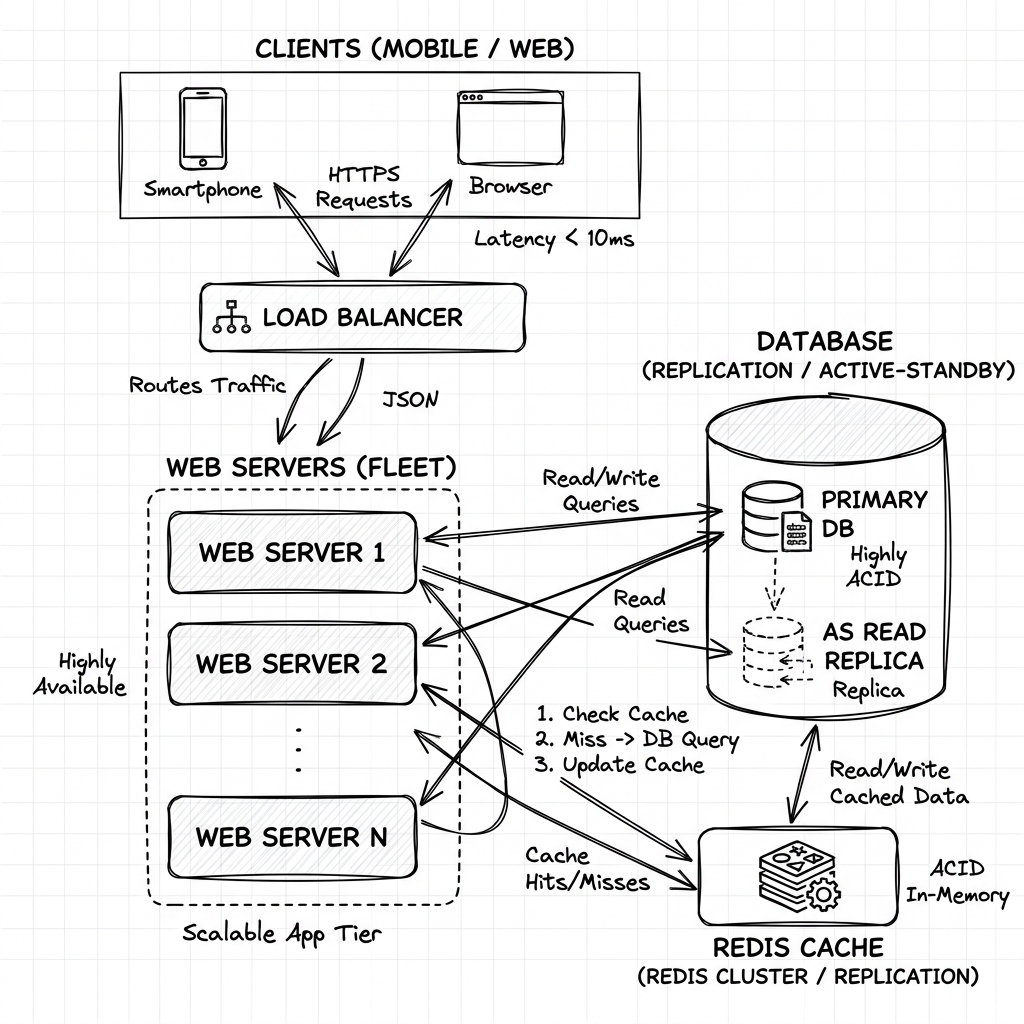
After evaluating countless candidates at top tech companies, we've gathered the most critical knowledge you need to succeed in system design interviews.
This approach offers two main benefits:
- If your interview is coming up soon, you can focus on the highest-impact topics without wasting time on unnecessary details.
- As you absorb new concepts, you'll relate them to actual systems and practical challenges, rather than memorizing abstract theories.
Many other resources either provide superficial overviews or dive so deep that you'd never realistically cover the material in a typical interview timeframe. Our goal is to strike the perfect balance.
We've designed this material to help you explore crucial architectural concepts efficiently, offering a solid foundation for building scalable applications.
Ready? Let's dive in.
What are system design interviews?
System design interviews evaluate your capacity to handle ambiguous, broad requirements and design a software architecture that fulfills them while scaling effectively.
Crucially, these sessions aren't about finding a single "correct" solution. Most problems have several viable architectures, each with distinct tradeoffs. The interviewer wants to see how you navigate these tradeoffs, justify your choices, and adapt when constraints change.
While entry-level roles rarely feature system design rounds, mid-level and senior positions almost always include them as a core component of the hiring process.
Types of System Design Interviews
Every organization has its own flavor of system design interviews. You might be asked to architect a specific product feature or design backend infrastructure to support a high-throughput service.
Typically, you'll be tasked with conceptualizing the architecture behind a well-known product (like a social feed) or a specific backend utility (like a rate limiter or message broker).
Ensure you're in the right place!
If your upcoming interview focuses on object-oriented class hierarchies or API design at the code level, you should look into Object-Oriented Design (OOD) resources.
Similarly, if you are preparing for Machine Learning architecture or Frontend system design, those require specialized preparation materials tailored to those domains.
Assessment
Interviewers use these sessions to gauge specific competencies through a structured dialogue.
Generally, while all candidates must deliver a functional architecture that meets the core requirements, higher-level roles demand a more proactive approach, deeper technical insights, and a stronger grasp of complex tradeoffs.
Every company has its own grading rubric, but they consistently evaluate candidates across four primary dimensions:
Problem Navigation
The interviewer wants to observe how you tackle a complex problem with vague requirements. This involves asking clarifying questions, defining the scope, and identifying the most critical constraints.
Common pitfalls include:
- Jumping into the design without gathering sufficient requirements.
- Wasting time on trivial features instead of the core technical challenges.
- Getting bogged down in one specific component and failing to complete the overall architecture.
- Not delivering a viable, end-to-end system by the end of the session.
A lack of structure is often the main reason candidates struggle. Following a clear framework can keep you on track.
Solution Design
Once the problem is scoped, the interviewer evaluates how you assemble various components to form a cohesive solution.
Common pitfalls include:
- Lacking fundamental knowledge of core architectural building blocks.
- Neglecting to address performance bottlenecks and scalability.
- Proposing a convoluted, unnecessarily complex architecture that is hard to maintain.
Interviewers can easily spot candidates who are merely reciting memorized architectures. They will challenge you by introducing unexpected constraints to see how your design adapts.
Technical Excellence
To architect an robust system, you must be familiar with industry best practices, modern technologies, and their appropriate use cases.
Common pitfalls include:
- Being unaware of standard infrastructural components (like message queues or distributed caches).
- Relying on outdated practices or legacy hardware assumptions.
- Applying the right technology to the wrong problem.
- Failing to recognize standard architectural patterns.
Technology evolves rapidly, so it's important to understand modern distributed systems principles rather than relying on outdated concepts.
Communication and Collaboration
Technical interviews also serve to assess your teamwork and communication skills. Interviewers want to see what it would be like to collaborate with you on a real engineering project.
Common pitfalls include:
- Struggling to articulate complex technical ideas clearly.
- Reacting defensively when the interviewer points out flaws or suggests alternatives.
- Ignoring the interviewer's hints or failing to collaborate effectively.
How to Use This Guide
We suggest reading through these materials sequentially, though you can skip areas you've already mastered. We've structured the content to be comprehensive and self-contained, avoiding the need to constantly reference external sources.
How much time do I need to prepare?
If system design is a completely new domain for you, expect to dedicate significant time to learning the core concepts before attempting practice interviews.
If you're pressed for time, focus first on mastering a structured delivery framework and the fundamental building blocks (like databases, caching, and load balancing) before diving into complex case studies.
Conclusion
We're thrilled to help you prepare for your upcoming interviews. If you have questions or feedback, feel free to drop them in the comments to help us continuously improve this material!