Introduction: The Dessert Buffet
Imagine you are at a massive dessert buffet, and you have a plate that can only hold 3 items. You want to get the most delicious plate of desserts possible.
You could sit down and calculate every single combination of 3 desserts to find the absolute mathematically perfect plate... OR, you could just use the Greedy Strategy:
- Look at all the desserts.
- Grab the single most delicious one you see.
- Look at what's left, and grab the most delicious one again.
- Do it one more time.
By just picking the best option right in front of you at each step, you end up with a pretty amazing plate of dessert without doing any hard thinking!
What is the Greedy Pattern?
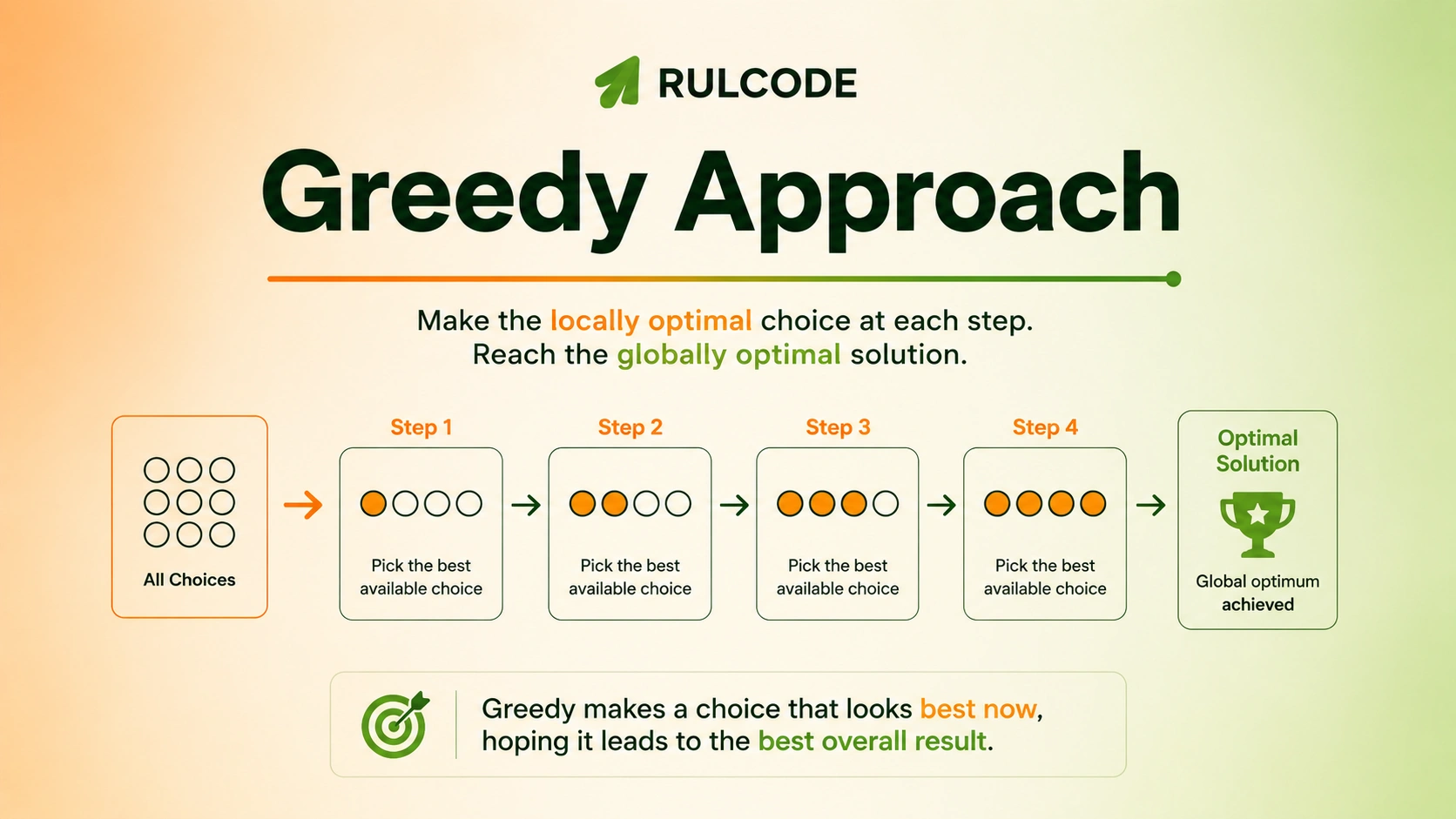
In programming, a Greedy Algorithm is a problem-solving strategy that makes the optimal (best) choice at each small step, hoping that these small best choices lead to the global best solution.
It doesn't look into the future. It doesn't double-check past choices. It just asks: "What is the best move I can make right exactly this second?"
Sometimes, being greedy is perfect (like giving change for a dollar). Sometimes, it leads you into a trap (like a maze where the shiny path leads to a dead end). But when it works, it is incredibly fast and simple!
The Core Strategy
- Sort or Organize: Greedy algorithms almost always require you to sort the data first (e.g., sort from biggest to smallest, or by ending time).
- Iterate: Go through the items one by one.
- Take the Best: Make the immediate best choice and add it to your total.
- Never Look Back: Once a choice is made, the greedy algorithm never undoes it.
️ Real-World Example: Giving Change
If you buy a toy for $3 and give the cashier a $10 bill, they need to give you $7 in change.
How does a cashier do it? They use a Greedy Algorithm!
- They grab the biggest bill possible without going over $7. (They grab a $5 bill).
- Now they owe you $2. They grab the biggest bill possible for $2. (They grab a $1 bill).
- Now they owe you $1. They grab another $1 bill.
They didn't have to calculate every combination of pennies and nickels. They just grabbed the biggest thing that fit, repeatedly!
Problem Walkthrough: Assign Cookies
Imagine you have some children, and each child has a "greed factor" (how big of a cookie they want). You also have a pile of cookies of different sizes. You want to make as many children happy as possible.
Interactive simulator for Assign Cookies. Step through the operations, inspect variables, and master the concepts dynamically.Assign Cookies
The Strategy
We should give the smallest cookies to the children with the smallest greed factors! Why waste a giant cookie on a kid who would be happy with a tiny one?
- Sort the children's greed factors from smallest to largest.
- Sort the cookies from smallest to largest.
- Use two pointers to match the smallest happy cookie to the easiest-to-please child.
Common Mistakes
- Forgetting to Sort: A greedy algorithm almost never works on unsorted data. If you just grab the first thing you see without organizing it first, you will make a bad choice.
- When Greedy is Wrong: Greedy doesn't always work! If a problem requires you to look ahead or test multiple overlapping combinations (like the famous Knapsack problem), you might need Dynamic Programming instead.
Practice Problems
- Assign Cookies — The classic introductory greedy problem.
- Jump Game — Be greedy about how far you can jump!
- Non-overlapping Intervals — Sort by end time and greedily pick intervals.
Interactive Visualizations
Engage with these concepts dynamically. Click on any card below to launch the interactive simulator and step through the algorithm execution.
Assign Cookies
Interactive simulator for Assign Cookies. Step through the operations, inspect variables, and master the concepts dynamically.