Master the Blind 75: The Only LeetCode List You Need for FAANG Interviews
Learn how 75 strategic problems and visual learning can land you your dream tech job faster than grinding 500+ random questions
You've probably heard it before: "Just grind LeetCode." But here's the truth that nobody tells you—grinding random problems is like trying to learn a language by memorizing random sentences. You might get lucky, but you'll never truly understand the underlying patterns. That's where the Blind 75 changes everything.
Created by a former Facebook engineer who interviewed at dozens of top companies, the Blind 75 isn't just another problem list—it's a battle-tested blueprint that teaches you the 7 core patterns appearing in 90% of all coding interviews.
In this comprehensive guide, we'll show you exactly how to master these 75 problems using Rulcode.com's interactive visualizations, transforming your preparation from overwhelming to systematic, and from frustrating to genuinely enjoyable.
What Makes the Blind 75 Different? (And Why It Works)
LeetCode has over 2,500 problems. Grinding through them all would take years. The Blind 75 cuts through the noise by focusing on quality over quantity—75 carefully selected problems that teach you reusable patterns, not one-off tricks.
Think of it like learning chess. You don't memorize every possible game—you learn opening principles, tactical patterns, and endgame techniques. Once you know these patterns, you can handle thousands of variations. The Blind 75 works exactly the same way for coding interviews.
The Numbers Don't Lie
- 75 problems vs 2,500+: Cover 90% of interview patterns with 3% of the problems
- 3-8 weeks to complete: A realistic timeline vs years of random grinding
- 7 core patterns: Master these and unlock thousands of problem variations
- Verified by thousands: Engineers at Google, Meta, Amazon, Microsoft, and Apple credit this list for their success
"I got offers from Google and Meta by focusing only on the Blind 75. Once you understand the patterns, you realize most interview questions are just variations of these 75 problems." — Former candidate, now at Google
Why Visual Learning is Your Secret Weapon
Here's a question: Have you ever read an algorithm explanation three times and still felt confused, but then watched a 2-minute visualization and everything instantly clicked? You're not alone. Science explains why.
Your brain processes visual information 60,000 times faster than text. When you see pointers move through an array, nodes connect in a graph, or a stack build and collapse in real-time on Rulcode.com, you're creating multiple neural pathways for that information. This is called dual coding theory—your brain stores both the visual representation AND the verbal explanation, creating redundant memory that you can recall under pressure.
What This Means for Your Interview Prep
- 65% better retention: Visual learners retain algorithms significantly longer and recall them faster during high-pressure interviews
- Pattern recognition on steroids: Your brain learns to spot "two elements converging" or "layer-by-layer traversal" automatically
- Reduced cognitive load: One cohesive animation vs holding 10 abstract steps in working memory
- Debugging intuition: After seeing algorithms execute visually, you can mentally "run" them during interviews
- Faster learning curve: What takes 2 hours to understand through text takes 20 minutes with visualization
This is exactly why Rulcode.com exists. We've built step-by-step interactive visualizations for 72+ algorithms, complete with code examples in Python, Java, C++, and TypeScript. You can watch each algorithm execute line by line, pause at any moment, and truly understand what's happening—not just memorize the code.
The 7 Patterns That Unlock Everything
Every problem in the Blind 75 falls into one of seven fundamental patterns. Master these patterns, and you can solve thousands of variations. Here's your roadmap:
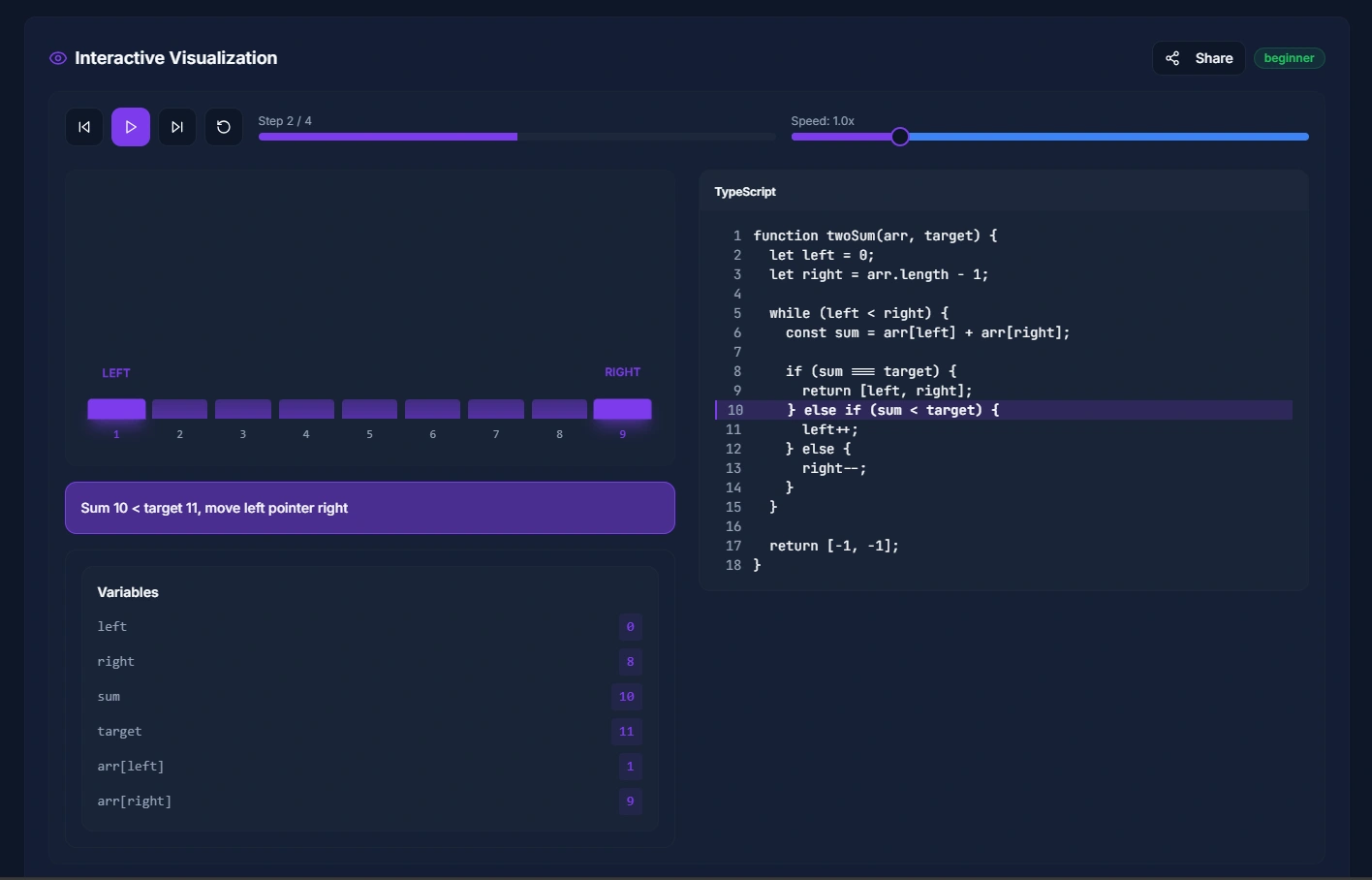
1. Two Pointers & Sliding Window (15 problems)
- The Pattern: Use two pointers moving toward each other or a window that slides across data to solve problems in O(n) time instead of O(n²).
- Key Problems: Two Sum II, Container With Most Water, Longest Substring Without Repeating Characters, Minimum Window Substring
- Why It Matters: This pattern appears in 20% of all FAANG interviews. Companies love it because it tests your ability to optimize brute force solutions.
- Visual Advantage: Watching pointers move and windows expand/contract on Rulcode.com makes the "aha moment" instant. You'll see exactly when to move which pointer and why.
2. Fast & Slow Pointers (5 problems)
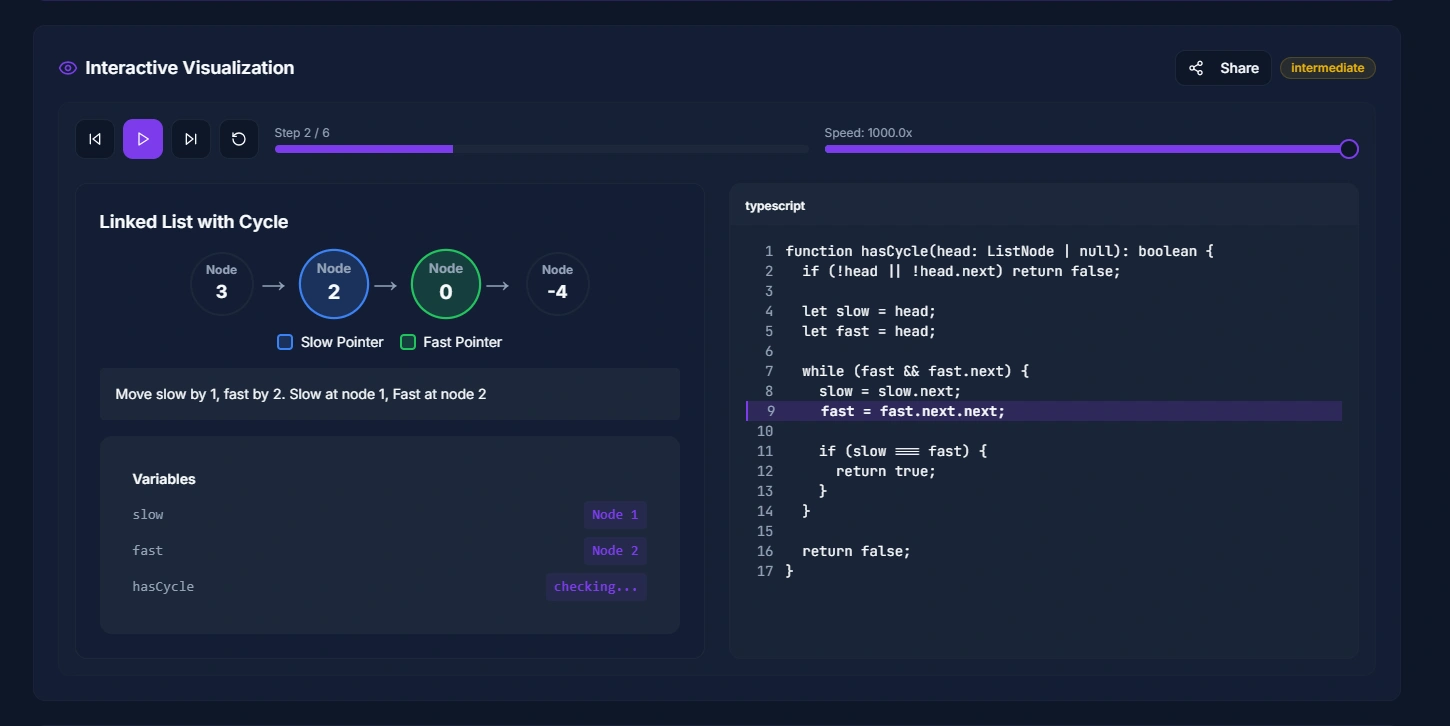
- The Pattern: Use two pointers moving at different speeds to detect cycles, find middle elements, or solve problems on linked lists.
- Key Problems: Linked List Cycle, Find the Duplicate Number, Middle of Linked List.
- Why It Matters: This pattern is elegant and frequently asked. It’s also a great way to show interviewers you understand pointer manipulation.
3. Binary Search & Modified Binary Search (7 problems)
- The Pattern: Divide and conquer sorted data to find elements in O(log n) time. The "modified" version applies binary search logic to unsorted problems.
- Key Problems: Search in Rotated Sorted Array, Find Minimum in Rotated Sorted Array, Time Based Key-Value Store.
- Why It Matters: Binary search is fundamental. If you can’t recognize when to apply it, you’ll struggle with medium and hard problems.

4. Tree & Graph Traversal (BFS/DFS) (20 problems)
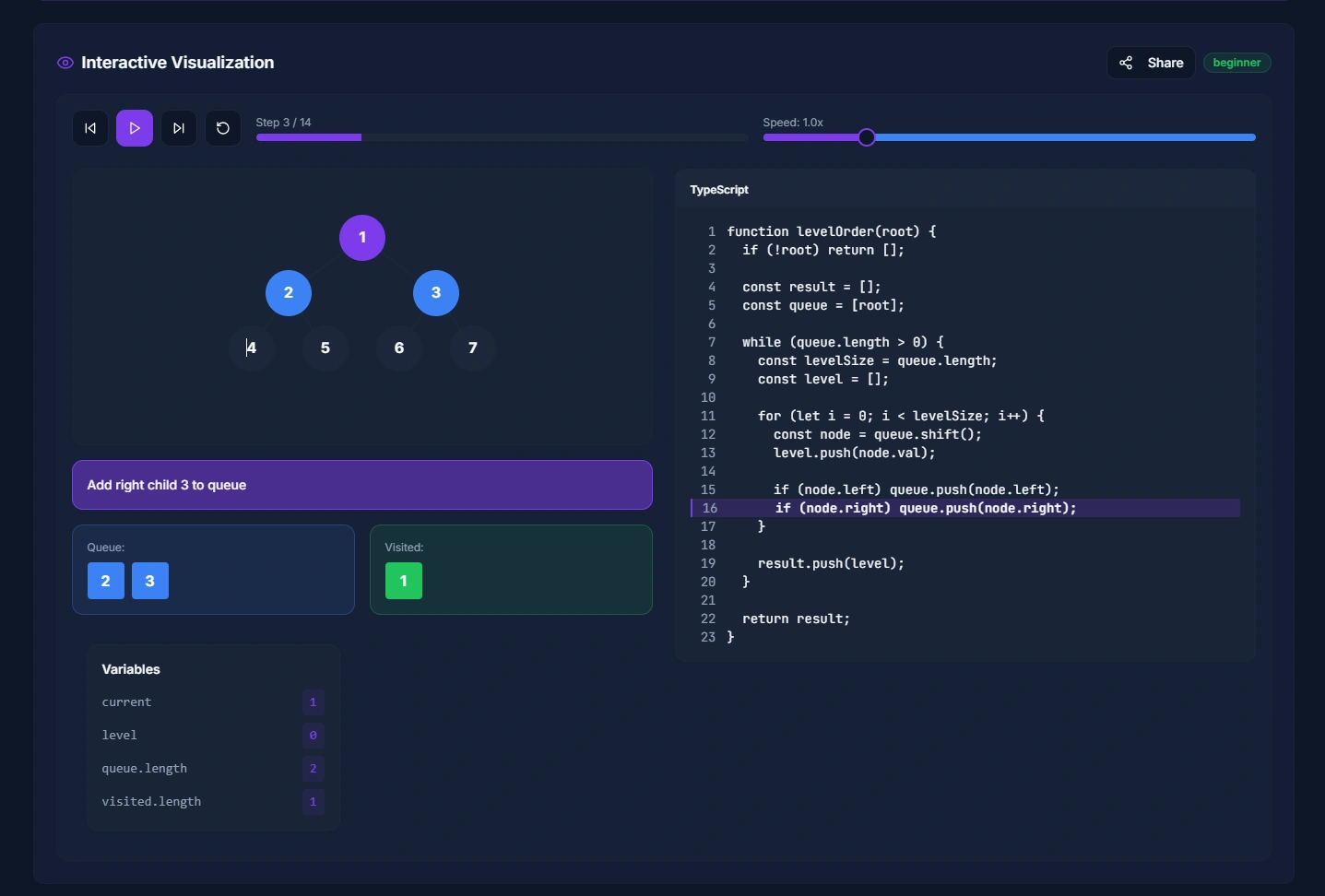
- The Pattern: Navigate hierarchical or networked data using Breadth-First Search (level by level) or Depth-First Search (dive deep first).
- Key Problems: Binary Tree Level Order Traversal, Number of Islands, Clone Graph, Course Schedule.
- Why It Matters: Tree and graph problems make up 25–30% of all interviews. They test recursion skills, queue/stack usage, and your ability to think spatially.
- Visual Advantage: Rulcode.com’s tree and graph visualizations make BFS vs DFS differences crystal clear.
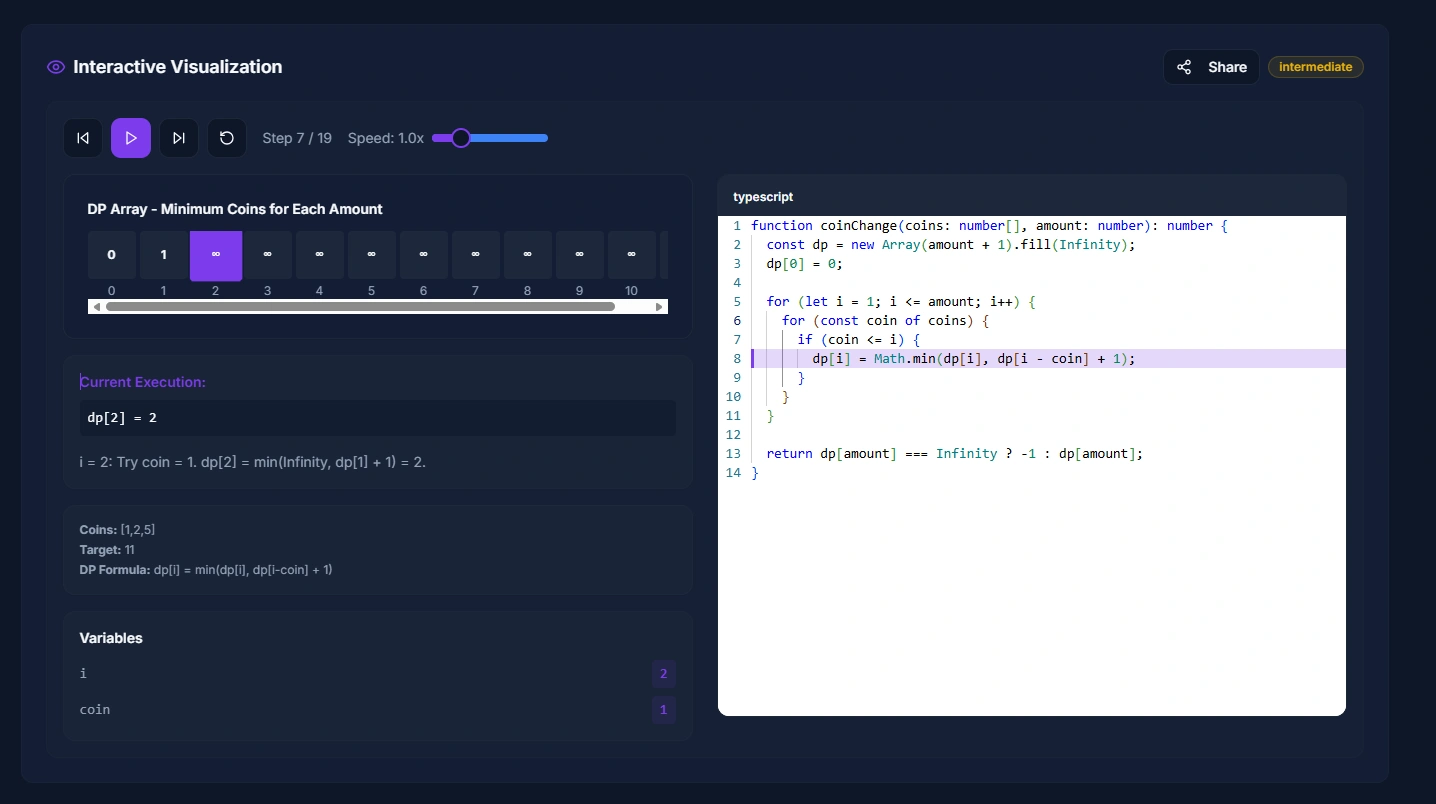
5. Dynamic Programming (15 problems)
- The Pattern: Break problems into overlapping subproblems and build solutions from smaller pieces. Use memoization (top-down) or tabulation (bottom-up).
- Key Problems: Climbing Stairs, Coin Change, Longest Increasing Subsequence, Word Break.
- Why It Matters: DP is the final boss of coding interviews. It separates strong candidates from average ones.
- Visual Advantage: Rulcode.com shows how subproblems overlap and how the DP table fills up, transforming confusion into clarity.
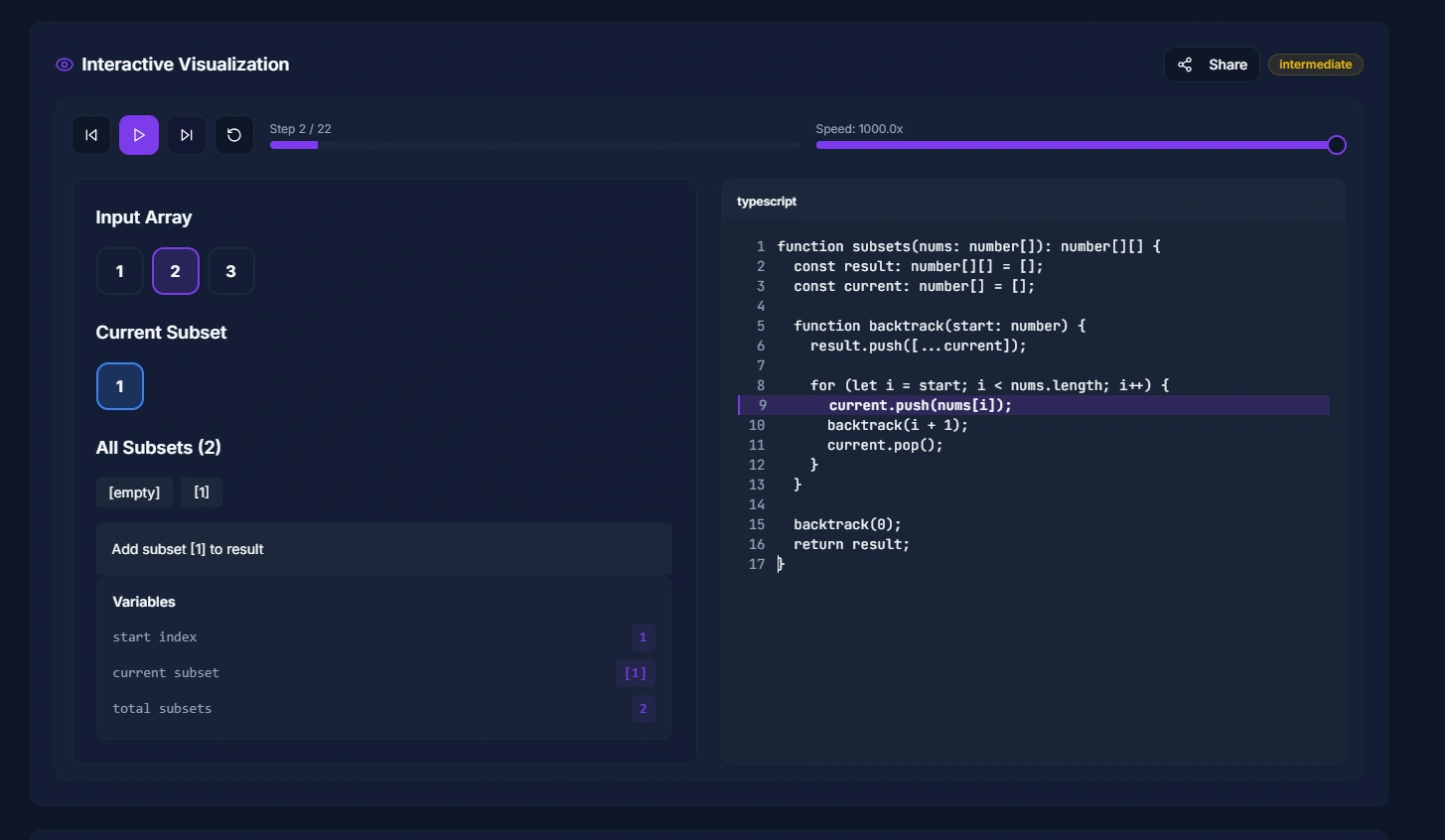
6. Backtracking & Recursion (8 problems)
- The Pattern: Explore all possible solutions by building them incrementally and backtracking when you hit dead ends.
- Key Problems: Subsets, Permutations, Combination Sum, Word Search.
- Why It Matters: These problems test your ability to think recursively and prune search spaces efficiently.
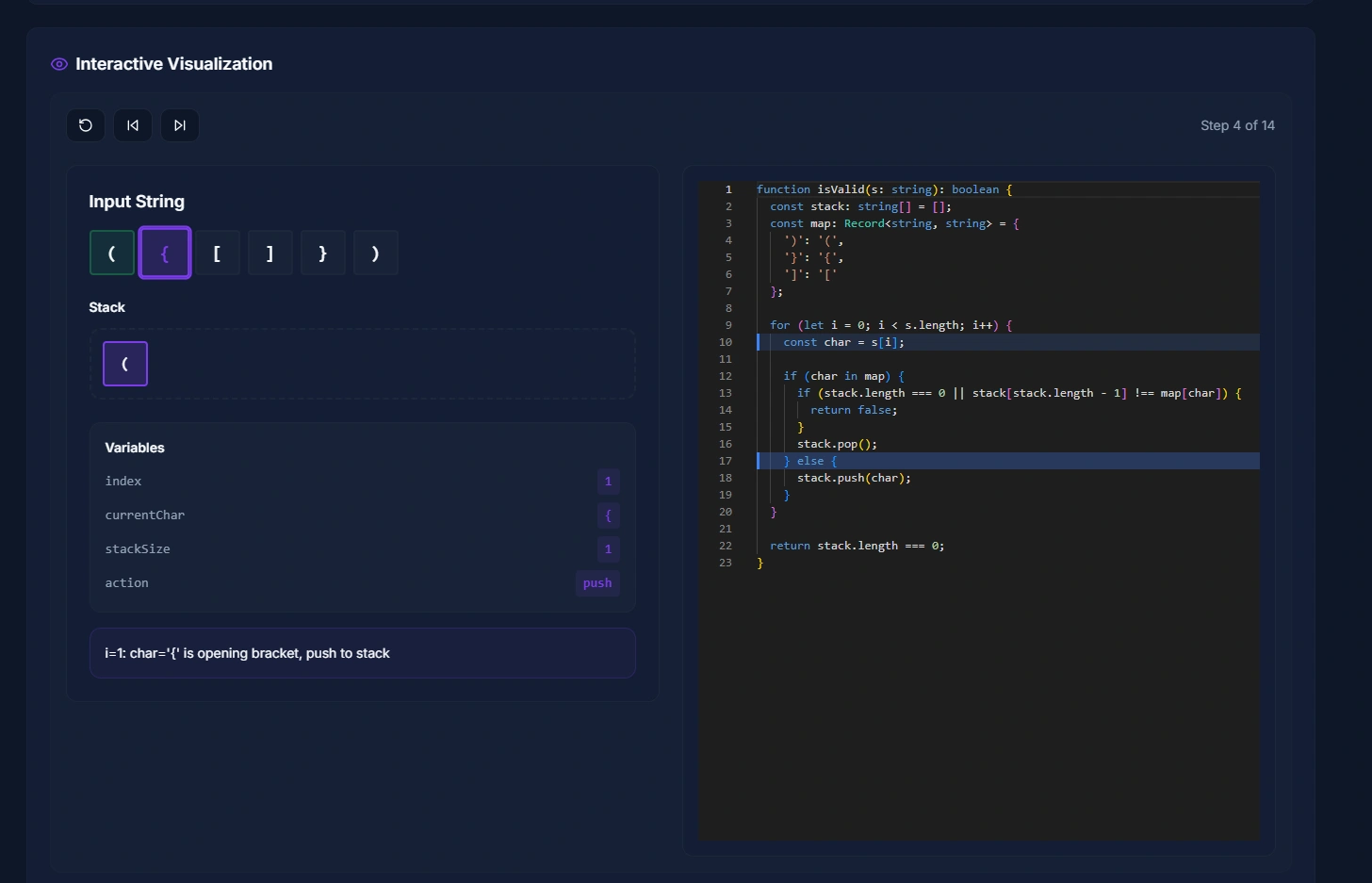
7. Stacks, Queues & Heaps (5 problems)
- The Pattern: Use LIFO (stacks), FIFO (queues), or priority-based structures (heaps) to solve problems involving ordering, scheduling, or processing.
- Key Problems: Valid Parentheses, Min Stack, Top K Frequent Elements, Merge K Sorted Lists.
- Why It Matters: These data structures are fundamental building blocks. Interviewers expect you to know when and how to use them.
Your 8-Week Battle Plan to Master the Blind 75
Here's a proven schedule that balances depth and breadth. Adjust based on your experience level and available time.
Weeks 1–2: Array & String Fundamentals (15 problems)
- Focus: Two Pointers, Sliding Window, Hashing.
- Why Start Here: These are the easiest patterns and build confidence. Arrays and strings appear in 40% of interviews.
- Rulcode.com Resources: Watch Two Sum, Container With Most Water, and Longest Substring visualizations first.
Weeks 3–4: Linked Lists & Binary Search (12 problems)
- Focus: Fast & Slow Pointers, Binary Search variations.
- Practice Tip: Draw linked lists on paper while watching Rulcode.com animations. This dual-channel learning accelerates retention.
Weeks 5–6: Trees & Graphs (20 problems)
- Focus: BFS, DFS, Recursion, Tree properties.
- Why It Gets Hard: Spatial reasoning is challenging. Use Rulcode.com’s graph visualizations religiously—they’re specifically designed to make these concepts intuitive.
Weeks 7-8: Dynamic Programming & Advanced Topics (18 problems)
- Focus: DP, Backtracking, Advanced data structures
- Reality Check: DP is where most people struggle. Don't rush. Watch each visualization multiple times. Understanding ONE DP problem deeply beats superficially memorizing ten.
Daily Study Routine (2-3 hours)
- Step 1 (20 min): Read the problem on LeetCode. Attempt it yourself for 15 minutes.
- Step 2 (30 min): Watch the algorithm visualization on Rulcode.com. Pause at each step and understand WHY, not just WHAT.
- Step 3 (40 min): Code the solution from scratch WITHOUT looking. Get stuck? Go back to the visualization.
- Step 4 (20 min): Review time/space complexity. Can you explain it out loud?
- Step 5 (10 min): Note down the pattern and any edge cases you missed.
Common Mistakes (And How to Avoid Them)
- 1: Memorizing solutions instead of patterns. Fix: Ask "What pattern did this use?" after solving.
- 2: Rushing through easy problems. Fix: Easy ones teach fundamentals—master them first.
- 3: Skipping the "why" behind algorithms. Fix: Understand reasoning, not just syntax.
- 4: Not timing yourself. Fix: Simulate interviews with a timer.
- 5: Giving up too early. Fix: Watch visualizations, then retry from scratch.
Is the Blind 75 Enough? (The Honest Answer)
For most mid-level software engineering roles at FAANG and similar companies: Yes, the Blind 75 is enough.
Countless engineers have landed offers at Google, Meta, Amazon, Microsoft, and Apple by mastering just these 75 problems. The key word is "mastering"—that means understanding the patterns so deeply that you can solve variations on the spot.
When You Might Need More:
- Senior/Staff roles: Add system design prep and leadership questions
- Specialized domains: If applying for ML Engineer roles, add ML-specific problems
- Competitive programming background: If you find Blind 75 too easy, move to Blind 150 or company-specific problem sets
- Second interview rounds: After mastering these 75, practice on LeetCode's company-tagged problems for your target companies
How Rulcode.com Supercharges Your Preparation
We built Rulcode.com because we were frustrated with traditional learning methods. Reading algorithm explanations felt like trying to understand a movie by reading the script. We needed to SEE it happen.
What Makes Rulcode.com Different:
- 72+ Algorithm Visualizations: Watch algorithms execute step-by-step with real-time animations
- Multi-Language Support: Code examples in Python, Java, C++, and TypeScript
- Direct LeetCode Links: One click from visualization to practice problem
- Complexity Analysis: Time and space complexity explained for every algorithm
- Interactive Controls: Pause, rewind, and replay at your own pace
- Open Source & Community-Led: Built transparently with full access to the source code
Whether you're a CS student prepping for your first interview, a self-taught developer breaking into tech, or an experienced engineer targeting FAANG, Rulcode.com meets you where you are.
Your Next Steps: Start Today
The best time to start was yesterday. The second best time is right now. Here's your action plan:
- Today: Pick one easy problem from the Two Pointers category. Watch it on Rulcode.com, then solve it on LeetCode.
- This Week: Solve 3-5 problems using the same pattern. Notice how they're all variations of the same technique.
- This Month: Complete Weeks 1-2 of the study plan. You'll have Two Pointers and Sliding Window down cold.
- In 8 Weeks: You'll have mastered all 75 problems and the 7 core patterns. You'll be ready to interview anywhere.
Remember: Every engineer who landed their dream job started exactly where you are now. The difference isn't talent—it's consistent, focused practice with the right resources.
Frequently Asked Questions
How long does it take to complete the Blind 75?
Most people complete it in 3-8 weeks, depending on their starting level and time commitment. If you can dedicate 2-3 hours daily, aim for 6 weeks. If you're working full-time, 8-10 weeks is realistic.
Do I need to know all data structures before starting?
You should know the basics: arrays, strings, linked lists, stacks, queues, trees, and graphs. If you're rusty, Rulcode.com has foundational visualizations to refresh your memory.
What if I can't solve a problem after 30 minutes?
This is normal, especially early on. Watch the Rulcode.com visualization to understand the approach, then close it and implement from scratch. The struggle is part of learning.
Should I do the problems in order?
Follow the pattern-based order in our study plan. Starting with Two Pointers and Sliding Window builds confidence and teaches optimization thinking from day one.
Can I use Rulcode.com during actual interviews?
No, but that's the point! Rulcode.com trains your brain to visualize algorithms mentally. After watching enough visualizations, you'll be able to "run" algorithms in your head during real interviews.
Final Thoughts: Pattern Recognition is Power
The Blind 75 isn't magic. It's a systematic approach to learning the patterns that power 90% of coding interviews. Combined with Rulcode.com's visual learning platform, you have everything you need to transform from interview anxiety to interview confidence.
The journey won't always be easy. You'll get stuck. You'll feel frustrated. But every problem you struggle through is building the pattern recognition that makes the next problem easier. And one day—sooner than you think—you'll sit down for an interview, see a problem, and immediately recognize: "Oh, this is just Sliding Window with a HashMap. I got this."
That's the moment everything changes. That's when you know you're ready.
Your dream job is waiting. The Blind 75 is your roadmap. Rulcode.com is your guide. All you need to do is start.
About the Author: Rulcode Team
The Rulcode Team is passionate about computer science, competitive coding, and interactive education. We build tools and write guides to help developers master complex algorithms and ace technical interviews.