Dynamic Programming for People Who Hate Dynamic Programming
Understand DP using visuals, animations, and real intuitive examples — not confusing formulas.
Introduction: You’re Not Alone (Most People Hate DP)
Why?
Because DP is invisible.
But here’s the good news:
DP becomes insanely easy when you visualize it.
- Instead of formulas, you see the recursion tree.
- Instead of jumping lines, you see transitions.
- Instead of guessing states, you see animations.
This article will teach DP using simple visuals and practical examples — not theory.
Dynamic Programming (DP) is infamous for being one of the most frustrating topics in coding interviews. Most people avoid it because DP is invisible — you can’t see the states, transitions, or recursion tree. Everything happens in your head, and that makes it feel impossible.
But here’s the secret: DP becomes simple when you can visualize it. Instead of memorizing formulas, you see the recursion expanding, the repeated subproblems, and the DP table building step by step. This blog makes DP so intuitive that even absolute beginners can understand it.
Why Dynamic Programming Feels Hard
Most learners struggle with DP for four very simple reasons: imagination, confusing definitions, unreadable tutorials, and hidden transitions.
1. DP requires imagination
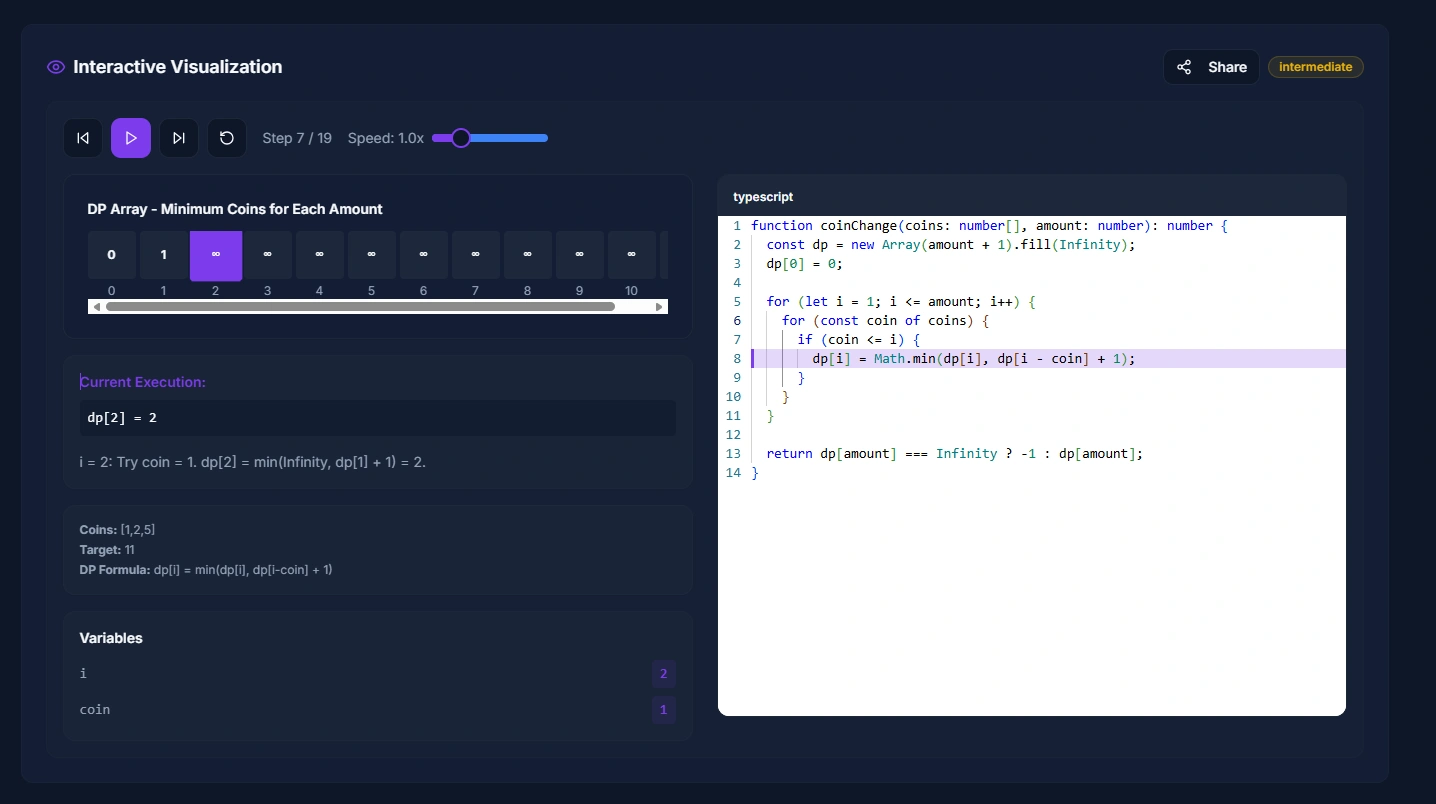
To understand recursion + memoization, you have to visualize how the recursion tree grows. Without visuals, everything feels abstract and overwhelming.
2. Definitions are confusing
Terms like overlapping subproblems or optimal substructure sound scientific. In reality, they're simple ideas: don’t recompute work, and build answers from smaller pieces.
3. Tutorial code hides the thought process
Most articles show the final DP solution, skipping the reasoning that leads to it. Without the steps, learners feel lost.
4. Transitions are not visually explained
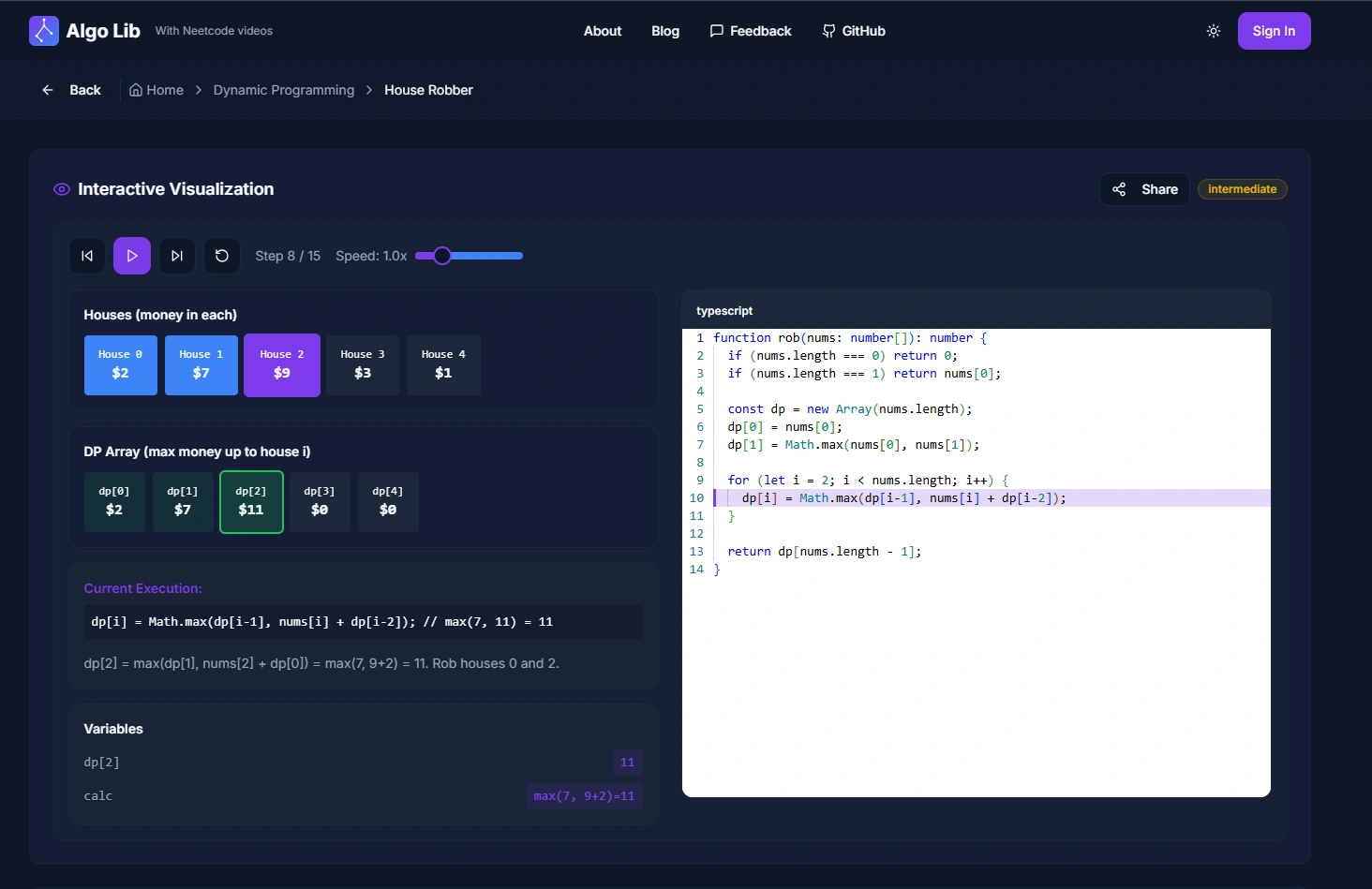
The most important part of DP is understanding how to move from one state to another. Unfortunately, tutorials rarely show transitions visually.
The Core Idea of DP in One Simple Line
Dynamic Programming = Recursion + Memory + Visual Patterns
If a problem can be solved using recursion, but recursion repeats work, then DP is simply the optimized version of that recursion — with memory and structure.
How to Instantly Identify a DP Problem
Use this simple formula: If a problem can be broken into choices and consequences, it's almost always DP. Here’s a quick checklist:
- Can the problem be expressed in terms of subproblems?
- Do you see repeated calculations?
- Does the final answer depend on previously calculated results?
- Can you express the logic recursively?
Why Visualizing DP Makes It 10× Easier
Rulcode.com makes DP simple by visually showing: recursion expansion, duplicate calls, memoization blocking repeated work, and DP tables filling cell-by-cell. This converts abstract theory into something you can SEE happening.
Why You Should Avoid Recursion in Fibonacci
Fibonacci is the perfect example of why plain recursion becomes extremely slow. The recursive formula looks simple: f(n) = f(n-1) + f(n-2). But the moment you try to compute even f(40), your program becomes painfully slow. Why? Because recursion repeats the same calculations thousands of times.
The Problem: Exponential Explosion
Each recursive call splits into two more calls. Those calls again split into two more. This creates a massive recursion tree where the same values (like f(3), f(4), f(5)) get computed again and again. This leads to an exponential time complexity: O(2^n).
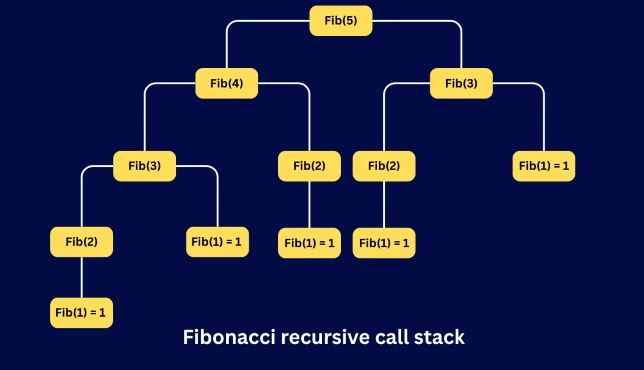
For example, while computing f(6), recursion computes f(3) three separate times. For f(40), the number of repeated calculations rises to millions. This is why naive recursion is extremely inefficient and should be avoided for Fibonacci.
Proof With Code
1function fib(n: number): number {2if (n <= 1) return n;3return fib(n - 1) + fib(n - 2); // Repeated work!4}5console.time('fib40');7console.log(fib(40)); // Slow8console.timeEnd('fib40');
This code works, but it grows extremely slow when n increases. It wastes time recomputing the same values over and over.
The Fix: Memoization (Top-Down DP)
Memoization stores previously calculated Fibonacci values so they don't repeat. This turns the complexity from O(2^n) to O(n).
1const memo: Record<number, number> = {};2function fibMemo(n: number): number {4if (n <= 1) return n;5if (memo[n] !== undefined) return memo[n];6memo[n] = fibMemo(n - 1) + fibMemo(n - 2);7return memo[n];8}9console.time('fib40_memo');11console.log(fibMemo(40)); // Fast12console.timeEnd('fib40_memo');
With memoization, each Fibonacci number is calculated only once. This dramatically speeds up execution and removes repeated branching from the recursion tree.
Let's Solve a Real DP Example: 0/1 Knapsack
You are given weights and values of items, and a knapsack with limited capacity. You must maximize value by choosing items — but each item can be taken only once (0/1 choice).
Step 1: Think Recursively – The Choice
For each item, you have two choices: include it or skip it. This choice-based structure is the foundation of DP.
Imagine you're going backpacking, but your backpack (the 'knapsack') can only hold a certain amount of weight. You have a pile of items, each with a different weight and a different personal value to you (e.g., a heavy book might be less valuable than a light, warm jacket).
1knapsack(i, capacity) = max(2value[i] + knapsack(i - 1, capacity - weight[i]), // include3knapsack(i - 1, capacity) // skip4)
Step 2: Memoize to Remove Repeated Work
Knapsack has huge overlapping subproblems. Memoization caches results so repeated states are instantly returned.
1const dp = Array(n + 1).fill(null).map(() => Array(cap + 1).fill(-1));2function knapsack(i, cap) {3if (i === 0 || cap === 0) return 0;4if (dp[i][cap] !== -1) return dp[i][cap];5if (weight[i] > cap) {7return dp[i][cap] = knapsack(i - 1, cap);8}9const include = value[i] + knapsack(i - 1, cap - weight[i]);11const skip = knapsack(i - 1, cap);12return dp[i][cap] = Math.max(include, skip);14}
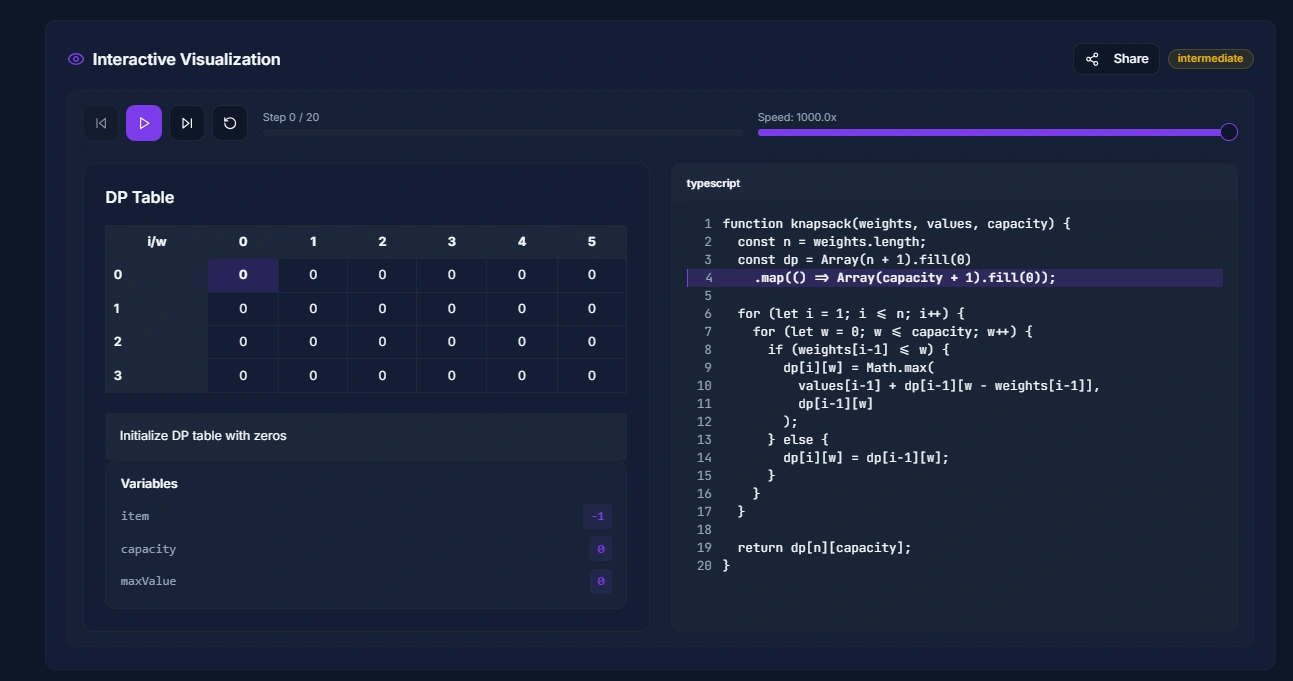
Step 3: Convert to Bottom-Up DP Table
Bottom-up DP builds the solution iteratively. Each cell dp[i][c] represents the best value using first i items and capacity c.
1function knapsack(weights, values, cap) {2const n = weights.length;3const dp = Array(n + 1).fill(null).map(() => Array(cap + 1).fill(0));4for (let i = 1; i <= n; i++) {6for (let c = 1; c <= cap; c++) {7if (weights[i - 1] <= c) {8const include = values[i - 1] + dp[i - 1][c - weights[i - 1]];9const skip = dp[i - 1][c];10dp[i][c] = Math.max(include, skip);11} else {12dp[i][c] = dp[i - 1][c];13}14}15}16return dp[n][cap];17}
The Only 5 DP Patterns You Ever Need
- Prefix/Suffix DP (Max subarray, House Robber)
- Knapsack / Choices DP (Pick or skip items)
- Subsequence DP (LCS, LIS, Edit Distance)
- DP on Grids (Paths, minimum cost, obstacles)
- DP on Trees / Graphs (Tree DP, DAG DP)
How Rulcode.com Helps You Master DP
Rulcode.com takes DP to another level with interactive visualizations:
- Step-by-step code execution
- Recursion tree expansion and collapse
- Memoization highlights
- DP table animations
- Multi-language code (Java, JS, TS, Python, C++)
- NeetCode-style walkthroughs + your own visual layers
About the Author: Rulcode Team
The Rulcode Team is passionate about computer science, competitive coding, and interactive education. We build tools and write guides to help developers master complex algorithms and ace technical interviews.